An Ontario Superior Court ruled Thursday that a billboard in northern Ontario calling then-prime minister Justin Trudeau a liar is protected as free expression under the Charter of Rights and Freedoms. The decision strikes down the province's policy banning political messaging on bush country highways.
Court rejects ministry's shifting justifications
Justice Andras Schreck said the case was not about whether George Katerberg's views on COVID-19 vaccines were correct, but about his right to express them. The court criticized the Ministry of Transportation's "shifting and inconsistent justifications" for blocking the sign.
Constitutional lawyer Chris Fleury, representing the Justice Centre for Constitutional Freedoms, said: "The decision is a welcome affirmation of the importance of political expression and that governments cannot prohibit political expression while at the same time permitting commercial advertising."

Billboard displayed faces of political leaders
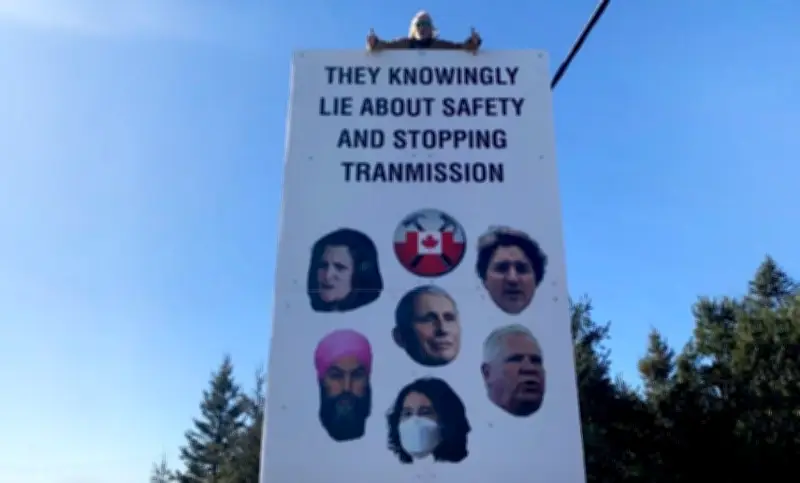
In 2022, Katerberg decided to put up a billboard expressing his views about politicians and public officials who had advocated for COVID-19 vaccines. He rented a billboard along Highway 17 near Thessalon, Ontario, for one year at a cost of $500. The Ministry of Transportation identified that stretch of highway as a "bush country highway."
The sign displayed the faces of Trudeau, Ontario Premier Doug Ford, federal NDP leader Jagmeet Singh, former chief public health officer Theresa Tam, former deputy prime minister Chrystia Freeland, and Anthony Fauci, former chief medical advisor to the U.S. president. Above the faces, Katerberg wrote: "They knowingly lie about safety and stopping transmission."
Ministry claimed logo was white supremacy symbol
In March 2024, Katerberg installed the sign. Later that month, Christopher Marsh, a corridor management officer with the ministry, ordered him to remove it because the logo—two hammers crossed in an "X" with a Canadian flag above them—was a "symbol of white supremacy." Katerberg said the image came from the cover of Pink Floyd's album The Wall.
Katerberg revised the sign, removed the logo, and emailed Marsh in June 2024 to say he planned to install the updated version. The ministry rejected the revised sign, saying the "message on the billboard may be seen as promoting hatred or contempt for the individuals pictured on the billboard, which may violate certain policies regarding advertising."
Ministry changed policy after admitting Charter violation
Months later, the ministry admitted it had violated Katerberg's Charter rights. However, instead of approving the sign, it amended the Highway Corridor Management Manual in April 2025, introducing a new policy banning political messages on billboards along bush country highways while continuing to allow commercial advertising and certain community messages.
The court rejected the ministry's arguments, "finding that political expression on roadside billboards is protected by the Charter" and that there was "no rational connection between banning political messages and the government's stated objective of maintaining the integrity of bush country highways."
Katerberg elated with ruling
Fleury said on July 9: "Mr. Katerberg is elated with today's ruling. The Court was correct to criticize the ministry's shifting and inconsistent justifications throughout the process." The Justice Centre added: "Governments cannot prohibit political expression, while at the same time permitting commercial advertisement."