The Great Parenting Divide: When Should Teens Gain Independence?
Children do not magically transform into fully functional adults upon turning eighteen. The skills necessary for navigating society are cultivated through countless small experiences throughout childhood. A recent viral social media exchange has ignited passionate discussion about one such formative moment—and whether modern parenting approaches might be hindering adolescent development.
The Viral Exchange That Sparked Controversy
User @luxemiaa shared a screenshot of a text conversation between a mother and her 13-year-old daughter's friend. The friend had asked if the daughter, Kailee, could join her at the movies. The mother responded with conditions that would become the focal point of intense online debate.
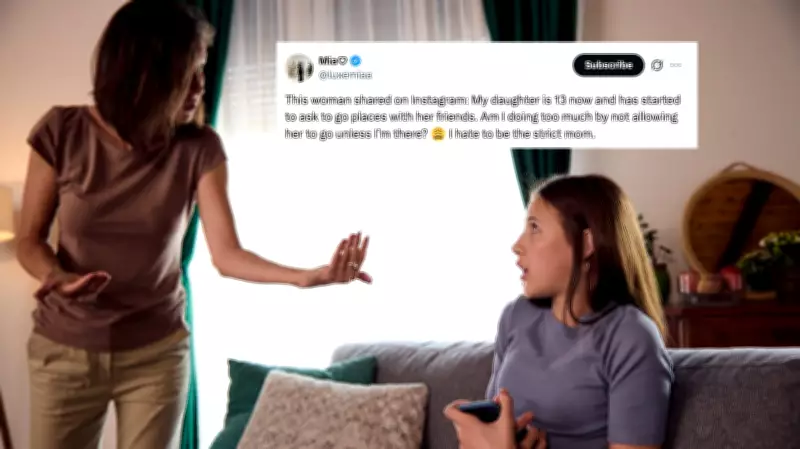
"My daughter is 13 now and has started to ask to go places with her friends. Am I doing too much by not allowing her to go unless I'm there?" the mother wrote in her original post, accompanied by a groaning face emoji. "I hate to be the strict mom."

In the text exchange, after gathering details about timing, the mother clarified her position: "Okay, I'll see if I'm available to be there. I don't just drop her off. I have to stay and watch y'all."
The teenage friend's response was brief and definitive: "It's ok she doesn't have to go," effectively ending the invitation as presented.
The Social Media Firestorm: Two Opposing Camps Emerge
This seemingly simple exchange divided internet commentators into distinct camps with fundamentally different views on parenting and adolescent development.
Critics of the mother's approach argued that such restrictions could harm a teen's social development:
- "Yes you're doing too much. Strict parents create sheltered children who sneak around and hide important things from them," wrote user @denisee_re.
- "This is so crazy to me because the cinema is literally the place 13 year olds hang out. That's like their main customers," noted @ShayWoulahan.
- "Holy shit has parenting changed. My mom used to kick us outside and lock the door on us in the summer," recalled @OpusBased, highlighting generational shifts in parenting norms.
Supporters of the mother's caution emphasized varying maturity levels and potential safety concerns:
- "Unpopular opinion, she's not wrong! Everyone is saying 'She's 13' there are different types of 13," argued @Reyannn3.
- "Yall in the thread saying mom is wrong are weird asf! SHES 13!!! HELLO!! And the fact that the friend said nevermind means something fishy going on!" insisted @skyy_bunny.
The Middle Ground: Seeking Age-Appropriate Compromises
Many users proposed balanced solutions that could address parental concerns while allowing teens some independence:
- "Maybe not go in with them but definitely pick up/drop off. You don't want her to become secretive and keep you out," suggested @StacieK94716.
- "if you're worried maybe jus hang in the parking lot while she's in the movies. compromise a little bit," offered @mlbtheshow25.
- "IF you want to be this person, how you do it is that you go to the movies with them but you go see a different movie instead," proposed @RealWashedGamer.
Expert Perspectives: The Psychology of Adolescent Independence
Child development professionals emphasize the importance of gradual autonomy while acknowledging parental concerns.
"Teens will soon be independent adults, and it's essential that parents provide them with opportunities to practice autonomy while they're still living under their roof," explained Jill Hartrich, a child therapist and parenting coach at Foundations Therapy.
Ciara Bogdanovic, psychotherapist and owner at Sagebrush Psychotherapy, highlighted the delicate balance required: "Too much monitoring and you risk your child never learning how to manage things on their own, developing low self-esteem and anxiety, and struggling to build and maintain relationships with their peers."

Hartrich noted that independent experiences are "essential for identity formation" and associated with numerous benefits including higher motivation, improved social connections, stronger cognitive skills, and lower rates of depression and anxiety.
The Scaffolding Approach: Gradual Steps Toward Independence
Both experts recommend "scaffolding" support—creating manageable opportunities for independence with oversight that can be gradually reduced.
"One way to scaffold is by starting with short outings," Bogdanovic suggested. "Like walking to the local grocery store with a friend and returning home, then over time increasing the teen's time away without parents."
Hartrich emphasized that this approach "helps kids build problem-solving skills so they can feel confident making smart decisions when they are without an adult."
Bogdanovic framed these experiences as crucial preparation: "Teens need time to do 'practice runs' of adulthood in low stakes settings so they can develop the skills to problem solve, assess risk and make safe choices, build confidence, ask for help when needed, and so on."
Navigating Modern Parenting in a Changed World
The debate reflects broader societal shifts in parenting norms and safety perceptions.
"It is true that independence milestones typically look different from what they did a few decades ago. The world also looks different, so it's understandable that parents have a higher level of anxiety," Hartrich acknowledged.
However, she noted that modern technology provides tools—phones and smartwatches—that can offer parents oversight without limiting adolescent growth. "While the world may feel different to parents, the drive for teen autonomy remains the same as when they were teens."
The conversation continues to evolve as parents navigate the complex terrain between protection and preparation, between safety concerns and developmental needs, in an era that looks markedly different from the free-range childhoods many adults remember.