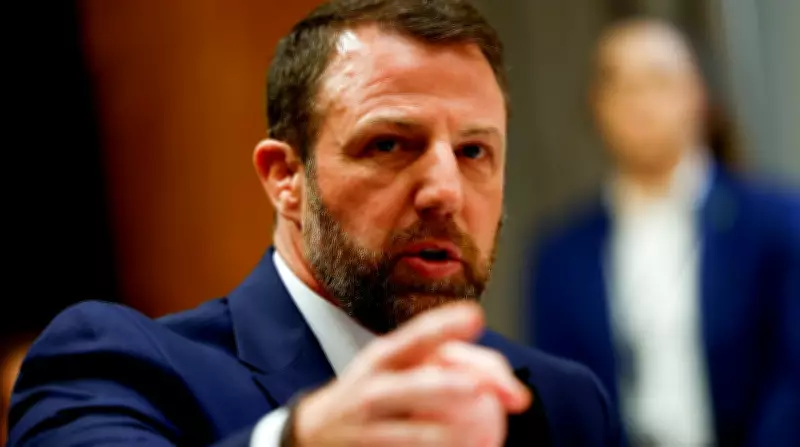
DHS Secretary's Parenting Comments Ignite Debate on Corporal Punishment
Markwayne Mullin, the recently appointed Secretary of the Department of Homeland Security under the Trump administration, has drawn significant attention for resurfaced comments regarding his approach to disciplining his six children. The former mixed martial arts fighter made these remarks during an October 2023 meeting with City Elders, a Christian political activist organization.
"I do spank. I have no problem with that," Mullin declared to the audience, who responded with applause. He elaborated with personal anecdotes, describing how his children would seek comfort from him shortly after being physically disciplined. "You can't imagine how loving they are. ... I can spank them and I'm still upset and they'll come and crawl on my lap two minutes later and just hug on me," Mullin recounted.
Scientific Consensus Contradicts Personal Testimonials
While Mullin's perspective finds sympathy in certain conservative parenting circles, it stands in stark opposition to decades of child development research. Experts universally condemn corporal punishment as harmful and ineffective.

"What we know from decades of research is actually very consistent," explained Jessica Scher Lisa, founder and clinical psychologist at Empowering Minds Consulting. "Spanking may stop a behavior in the moment, but over time it is linked to increased aggression, more defiance, higher rates of anxiety and depression, and a weaker parent-child relationship. It does not teach the skills we want kids to develop, like emotional regulation, communication or problem solving."
The World Health Organization reinforced this position in a comprehensive 2025 report. "There is now overwhelming scientific evidence that corporal punishment carries multiple risks to the health of children," stated Etienne Krug, director of the WHO Department for Health Determinants, Promotion and Prevention. "It offers no benefits to the behavior, development or well-being of children and no benefit to parents or societies either."
Neurological and Psychological Impacts Documented
Research reveals disturbing neurological consequences of physical discipline. Fiona Yassin, an international family psychotherapist and founder of The Wave Clinic, highlighted studies showing that children subjected to corporal punishment at age three face increased risks of poor mental health and behavioral problems later in life.
Perhaps more alarming is neurological research from Harvard University indicating that a child's brain responds to disciplinary hitting similarly to how it responds to severe maltreatment. The brain interprets these punishment smacks as threats, with the same neurological pathways activating as in cases of abuse. This research, building upon studies dating back to the 1980s, demonstrates that children's brains do not differentiate between disciplinary hitting and other forms of physical harm.
The Psychology Behind Public Endorsement
Experts note that parents who publicly endorse corporal punishment often do so for complex psychological reasons. "In my clinical work, this is usually not about a lack of care for their child," Scher Lisa observed. "It is often about normalization. Many of these parents were raised with physical punishment themselves, so it feels familiar and effective. Over time, it becomes part of their identity as a parent."
John Puls, a psychotherapist and licensed clinical social worker, adds another dimension: These public declarations sometimes serve as a "badge of honor" for parents wishing to signal their rejection of modern parenting techniques and their adherence to traditional, authoritarian approaches.
Mullin's own comments illustrate this intergenerational cycle. He described being raised "by the fear of a belt" and expressed admiration for his father's speed in administering punishment, noting he felt he "deserved" such discipline.

Breaking the Cycle Requires Conscious Effort
Child development specialists emphasize that breaking these cycles of physical discipline requires intentional, often difficult, changes in parental behavior. "The most important message I would want parents to hear is that kids learn by watching us," Scher Lisa emphasized. "If we want them to manage frustration, use words, and regulate their behavior, we have to model that for them."
For parents raised with corporal punishment, this means consciously choosing different approaches despite automatic impulses toward physical discipline. "That is not easy, but it is absolutely possible and it makes a meaningful difference in how kids grow and relate to others," Scher Lisa concluded.
The controversy surrounding Mullin's comments highlights the persistent gap between certain parenting subcultures and established scientific understanding of child development. While physical discipline remains normalized in some communities, experts maintain that ending the practice benefits children, families, and society as a whole.