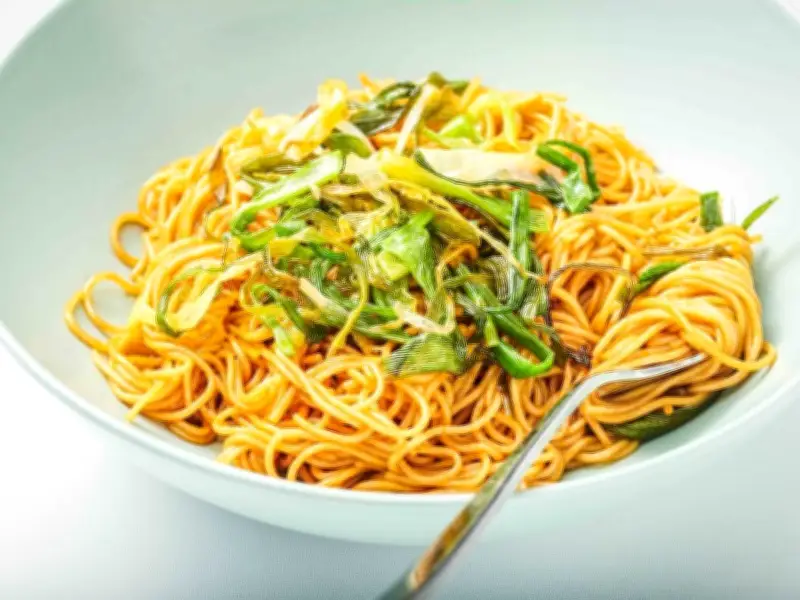
Making scallion oil actually gives you two rewards for the price of one. There is the flavoured oil, and then there are the jammy, caramelized, crisp-edged scallions. Most scallion oil noodle recipes make use of both: the oil becomes part of the sauce, while the cooked whites and greens serve as the topping. For the minimal amount of hands-on effort required to make scallion oil, it overdelivers on return.
The first time I made scallion oil noodles (cong you ban mian) at home, I could hardly believe how easy it was. Before that, I had only tasted the dish in restaurants and the homes of my relatives. A lot of my extended family lives in the Jiangnan region in eastern China, where the dish hails from. Every version I had tasted as a kid had been deeply savoury and rich with allium sweetness, and I had assumed the complexity of the flavour hinted at a long list of seasonings. Only after making the dish in my own kitchen did I realize that scallion oil – a key component in the sauce for the noodles – gives back much more than is put in.
While raw scallions may taste sharp and assertive, they mellow as they gently cook in a neutral oil for about 10 minutes, which softens their sulphurous quality while drawing out the allium's sweet notes and grassy, vegetal depth. The whites go into the pan first, because they take a little longer to soften, followed by the greens. As the scallions cook, their flavour compounds enrich the oil, producing a versatile condiment with concentrated flavour, one that adds a rounded savouriness to anything it touches.

I have drizzled scallion oil over rice and porridge, spooned it over steamed fish and roasted meat, and used it as the base oil for stir-fries and scrambled eggs. I have dipped dumplings into it and used it as a finishing touch on simple soups. And I have turned it into the foundation for many bowls of scallion oil noodles, just by stirring the oil with a little soy sauce and sugar before tossing it with the noodles.
Chili crisp has turned into a household name, but making it at home tends to require a longer list of spices and aromatics and more precise temperature control. Fresh herb oils often call for more steps, including blanching, drying and blending. Scallion oil takes less effort and involves less equipment, keeps well in the fridge for up to a week, and is no less versatile.
Scallion Oil Noodles Recipe
Servings: 4-6 (makes about 6 cups)
Active time: 40 mins; total time: 50 mins
Scallion oil noodles, a specialty of Shanghai and the greater Jiangnan region in eastern China, showcase the allium sweetness and mellow pungency of one of the most versatile aromatics in Chinese cuisine. Cooking scallions low and slow draws out their aroma, which infuses the oil that becomes part of the sauce for this dish.
Make ahead: The fried scallions and oil-soy-sauce mixture can be prepared and refrigerated separately for up to 1 week. The scallions may lose some fragrance after a few days.
Storage: Refrigerate for up to 3 days.
Where to buy: Fresh thin wheat noodles and dark soy sauce, which is typically thicker, sweeter and less salty than light (regular) soy sauce, can be found at Asian markets and well-stocked supermarkets. Look for noodles that are about 1/8 inch thick; they may be labelled yang chun.

Ingredients
- 8 scallions, ends trimmed (about 5 ounces)
- 1/4 cup plus 2 teaspoons neutral oil, such as vegetable or canola, divided
- 3 tablespoons light (regular) soy sauce
- 2 tablespoons dark soy sauce
- 2 1/2 teaspoons granulated sugar
- 14 ounces fresh thin wheat noodles
Directions
- Pat the scallions dry with a clean towel. Halve them crosswise to separate the whites from the greens, then cut into strips that are about 3 inches long and 1/4 inch wide (julienne), still keeping the whites and greens separate.
- In a medium (4-quart) saucepan or wok set over medium heat, combine 1/4 cup of the vegetable oil and the scallion whites, spreading the scallions into an even layer. Cook, stirring occasionally to ensure even browning, until the scallion whites have wilted slightly, about 2 minutes. Add the scallion greens and continue cooking, stirring occasionally and reducing the heat as needed to prevent scorching, until the scallions are crisp and somewhat golden brown at the edges (the color will vary), 10 to 13 minutes more. Remove from the heat and, using tongs, transfer the scallions to a towel-lined plate. To the oil remaining in the pan, add the light soy sauce, dark soy sauce and sugar, and stir until the sugar dissolves.
- While the scallions cook, bring a medium (3-to-4-quart) pot of water to a boil over high heat. Add the noodles, reduce the heat to medium, and cook, using chopsticks or tongs to gently break the noodles apart if they stick together, until they are tender with a slight chew, 2 to 3 minutes. (See Notes.) Drain the noodles in a fine-mesh sieve (they are thin enough to go through the holes of a regular colander), then transfer to a large sheet pan and drizzle the remaining 2 teaspoons of vegetable oil over them. Using tongs, toss well to evenly coat, then spread the noodles into an even layer and refrigerate for 10 minutes.
- Add the noodles to the oil-soy-sauce mixture and toss well to evenly coat. Divide among serving bowls and garnish with the fried scallions.
Substitutions
Fresh wheat noodles: thin dried wheat noodles cooked according to the package instructions, though they will most likely have a less bouncy, springy texture. Take care not to overcook them. Dark soy sauce: light soy sauce, plus an additional 1/2 teaspoon granulated sugar. Granulated sugar: brown sugar.
Notes
Different noodle brands vary in cook time, so take the package instructions into account when cooking.
Nutritional facts per serving (1 cup), based on 6: Calories: 332, Fat: 12 g, Saturated Fat: 1 g, Carbohydrates: 49 g, Sodium: 824 mg, Cholesterol: 0 mg, Protein: 8 g, Fiber: 3 g, Sugar: 6 g. This analysis is an estimate based on available ingredients and this preparation. It should not substitute for a dietitian’s or nutritionist’s advice.
From food writer Megan Zhang.