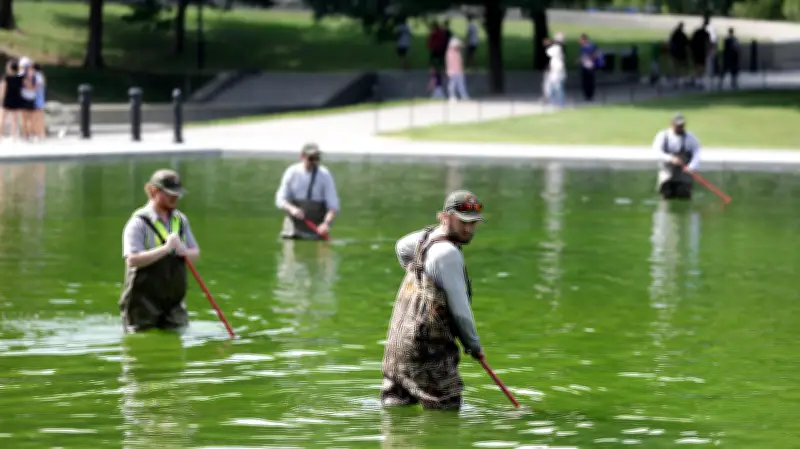
President Donald Trump’s newly renovated Lincoln Memorial reflecting pool has turned a murky green, drawing comparisons to “puke green” and “split pea soup.” Critics have coined phrases like “Make Algae Great Again” and “Make Algae Green Again” to mock the situation.
The $14 Million Renovation
Trump spent $14 million on upgrades to the iconic Washington, D.C., landmark, aiming to make the pool “function properly” with sparkling blue water. The pool was drained and painted a shade Trump calls “American flag blue.” However, experts warned from the start that the project lacked plans to fix underlying pipe infrastructure, and a new coat of paint would not solve the longstanding algae problem.
Algae Bloom Emerges
The result is now evident: algae has taken over the pool, and workers are scrambling to control it, especially ahead of the Fourth of July 250th anniversary celebrations. “Treatment of algae blooms is very costly and time-consuming,” said Sarah Goodrich, an adjunct professor at the University of Cincinnati. Factors such as hot temperatures, stagnant water, and high nutrient levels create an ideal environment for algae growth.

Steve Goodale, owner of Swimming Pool Steve pool service, noted that algae is natural in stagnant water. “Swamps are green and full of growth and algae,” he said. The pool holds roughly 6.5 million gallons of water, making algae control a major challenge.
Paint Color Worsens Problem
Painting the pool a darker “American flag blue” likely exacerbated the issue. “If you change a body of water from a light color to a dark color, it will absorb more heat,” Goodale explained. Warmer water directly leads to more algae growth. Additionally, the paint may contain nitrogen and phosphorus compounds that feed algae, according to Goodrich.
Sabotage Claims Dismissed
Some Trump supporters have suggested the algae bloom is sabotage by Democrats. Experts dismiss this as unlikely. “Algae is readily making its way into the pool already because of its open-air environment,” Goodale said. “Nobody needs to add algae.”
Interior Department spokesperson Katie Martin called it “residual algae” from dormant pipes. Goodale acknowledged this could contribute if pipes weren’t cleaned, but added, “I think that water was very likely to turn green regardless.”
Remediation Efforts
Workers have poured hydrogen peroxide into the pool and installed a nanobubbler system that injects ozone to combat algae. However, experts doubt these measures will be sufficient. Goodale noted that hydrogen peroxide dissipates quickly and requires multiple applications, which is expensive. Hans Paerl, a research professor at UNC Chapel Hill, called it “a temporary fix” because hydrogen peroxide is active for only a few weeks.
The nanobubbler system introduces oxygen to keep water clean, but the pool remains open to contamination from pollen, duck droppings, and other debris. “They’re fighting an uphill battle,” Goodale said.
Climate Change Factor
Climate change is expected to worsen algae problems in the reflecting pool and beyond. “Algae like it hot,” Paerl said. Warmer temperatures and longer warm seasons expand the window for algae blooms. “These kinds of issues are only going to get worse,” he added, noting that blooms are now appearing in northern regions like Canada and Nordic countries.
As temperatures rise earlier and stay high later, algae blooms start earlier and persist longer, making ongoing algae removal efforts likely in the months and years ahead.