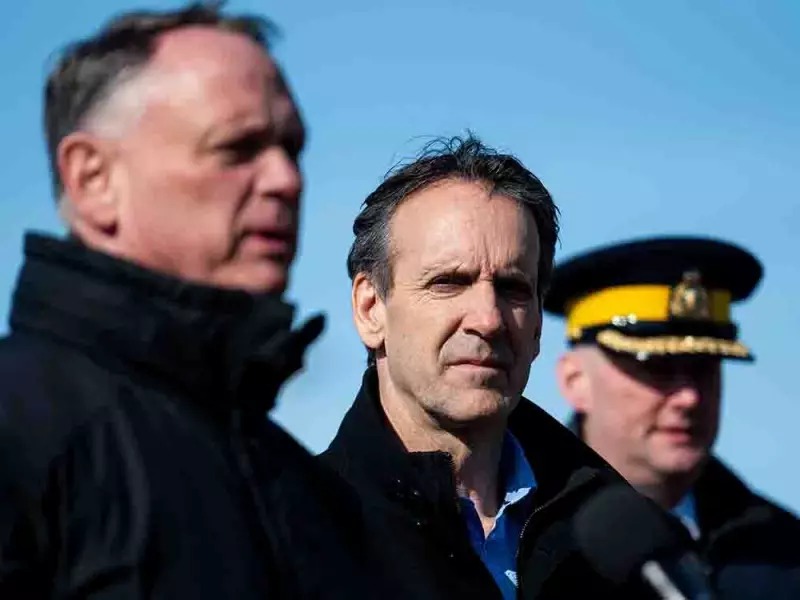
In a significant move to combat the deadly opioid epidemic, the Canadian government is seeking closer collaboration with China to stem the flow of chemicals used to manufacture fentanyl. Kevin Brosseau, appointed as Canada's fentanyl czar in February 2025, emphasized the need for international partnership, stating the issue lies with specific chemical companies, not the Chinese government itself.
A Coordinated International Strategy
Brosseau, the point person for Prime Minister Mark Carney on the opioid file, clarified Canada's position in an interview. "We're looking to collaborate with China, because it's not an indictment against the Chinese government, per se," he said. He acknowledged actions Beijing has already taken to regulate and prohibit various precursor substances. The dialogue with Chinese officials was revived around the time of his appointment, aligning with broader efforts to mend economic ties.
This diplomatic push comes as Prime Minister Carney prepares to visit Chinese President Xi Jinping next year. The meeting is part of a strategy to improve relations amid a protracted trade dispute that has seen both nations impose high tariffs on each other's goods.

Border Security and the U.S. Tariff Dispute
Concurrently, the Canadian government launched a substantial $1.3 billion border security plan. This initiative funds new equipment, including helicopters, drones, and surveillance towers, to enhance interception capabilities. Despite this domestic investment, the United States under President Donald Trump levied 25% emergency tariffs on Canada and Mexico, accusing both of allowing "massive" amounts of fentanyl across their borders.
The White House later raised the base tariff on Canada to 35%, though most goods are exempt if they comply with the USMCA. This tariff move is currently being challenged at the U.S. Supreme Court. Brosseau countered the U.S. claims with data, noting that fentanyl seizures at the U.S.-Canada border averaged just 3.5 pounds per month over a recent three-year period, a tiny fraction of the volume seized at the southern border with Mexico.
The Production Chain and Enforcement Success
Brosseau outlined the complex transnational production chain. U.S. intelligence agencies identify China as the primary source for illicit fentanyl precursor chemicals and pill-pressing equipment, with India also involved. However, the final production of the drug occurs largely within North America. Fentanyl destined for the U.S. market is made domestically and in Mexico, while fentanyl for Canada is produced within Canada.
"There's very little north-south movement of produced fentanyl across the borders," Brosseau stated. He supported this theory by pointing to similar recent declines in opioid overdose rates in both countries. Within Canada, a concerted law enforcement "sprint" this year led to the seizure of 386 kilograms (851 pounds) of fentanyl and 270 kilograms of precursors—more than ten times the amount intercepted by American agents at the northern border so far this year.
The spike in seizures within Canada, including two unusually large interceptions in April and May 2025, demonstrates the effectiveness of targeted domestic operations. As Canada pushes for greater international cooperation to choke off the supply of precursor chemicals at their source, it continues to bolster its own border and internal enforcement measures in a multi-pronged attack on the crisis.