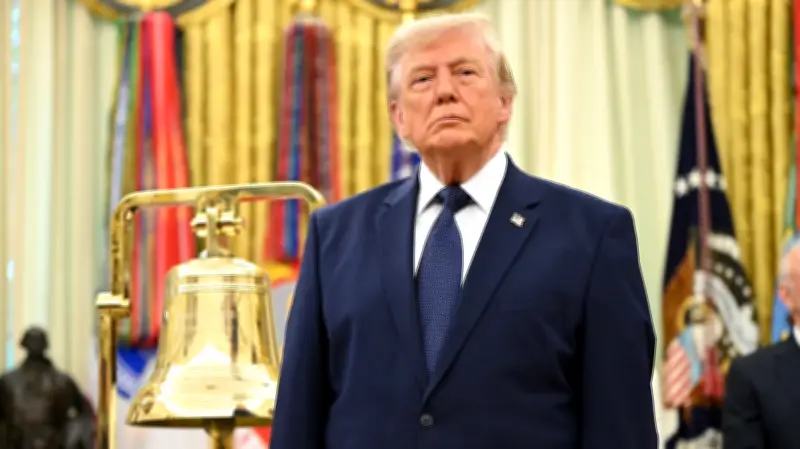
President Donald Trump, during a meeting with Turkish President Recep Tayyip Erdogan in Ankara on Tuesday, expressed delight at seeing a building he believed was named after him. "Just landing at the airport, to see such a beautiful airport, and to have a building named after me. I was very happy about that," Trump said. It remains unclear which building he referred to, as no structures in Ankara bear his name, though a Trump Towers complex in Istanbul operates under a license partnership.
This incident follows Trump's comments the previous day about the Trump Accounts program, where he claimed the branding was not his decision but admitted to demanding his name be used "in certain other cases," drawing knowing laughter from his audience. The pattern of self-branding is well-documented: during his second term, Trump's name has been added to the John F. Kennedy Center for the Performing Arts, the U.S. Institute of Peace was renamed the Donald J. Trump U.S. Institute of Peace, and government buildings have displayed massive banners with his face. Other examples include commemorative "Trump passports," "Trump Gold Cards," a "TrumpRx" website for discounted drugs, and National Park Service annual passes featuring his image.
Psychological Patterns Behind the Branding
Experts note that this fixation on naming and branding defies longstanding norms for sitting presidents and aligns with narcissistic characteristics. Tina Swithin, author of "Divorcing a Narcissist: One Mom's Battle," said, "The fixation on naming, on visible and permanent markers of significance, is consistent with what I describe to my clients as legacy-driven narcissistic supply. It is not enough to accomplish something. The accomplishment must be branded, displayed and permanently attributed." She added, "We are talking about someone who has spent decades putting his name on buildings, golf courses, steaks and airlines. That is not a coincidence. That is a pattern."

Narcissistic supply refers to the attention, admiration, and validation narcissists require to maintain their self-worth. Marie-Line Germain, author of "Narcissism at Work: Personality Disorders of Corporate Leaders" and a professor at Western Carolina University, explained, "The visible recognition reinforces their self-image and signals to others that they deserve admiration. In their eyes, it legitimizes their worth."
Public Recognition as a Requirement
For individuals with narcissistic tendencies, private acknowledgment is insufficient. "The supply has to be public or it doesn't count," Swithin said. "A building, a monument, a named institution — these are not just honors. They are permanent, physical declarations of importance that continue generating admiration long after the moment has passed. A simple thank you card is not going to satisfy someone who is two steps ahead, already mentally designing the plaque."
Psychiatrist Dr. Sue Varma noted that healthy recognition is based on hard work and includes humility. "It also doesn't put down anyone else, but rather accurately identifies the giants whose shoulders they had to stand on," she said. In contrast, narcissists take this to an entitlement level. "The difference is that for most people, recognition is a bonus," Swithin explained. "It is affirming, but it is not essential. A person with a secure sense of self can do meaningful work without needing the world to know about it." For narcissists, recognition is "a requirement and functions more like oxygen than applause."
Grandiose Recognition and Its Consequences
Therapist Wendy Behary, author of "Disarming The Narcissist," emphasized that narcissists want public admiration and envy. "It's about living in this grandiose fantasy where everyone is impressed with your magic, your majesty, your talent, your good looks," she said. "Because narcissists carry so much insecurity at the core of their existence, having that very large recognition, winning someone over, winning a competition is really crucial for their sense of well-being and their sense of acceptance."

Virginia Gilbert, a licensed marriage and family therapist, added, "Because narcissists don't have a solid identity or healthy self-esteem, they are constantly looking for the next, biggest, shiniest status symbol to signal to the world that they are special — sprawling mansions, gold-plated plaques bearing their names on public edifices, a yacht or private jet that's bigger than anyone else's." Recognition is fleeting, however, leading to an insatiable pursuit. "No amount of recognition ever fully fills the void because the need is insatiable," Swithin said. "At its core, that insatiability is rooted in shame and an identity that depends entirely on external sources of validation to survive."
Reaction to Insufficient Credit
When narcissists feel their contributions are overlooked, the response can be severe. "This is where the mask often begins to slip," Swithin said. "When a narcissist feels their contributions are being overlooked or minimized, the response is rarely quiet disappointment. It escalates quickly into grievance, resentment, and retaliation." She noted that in families, a narcissistic co-parent who wasn't acknowledged at a school event might turn it into weeks of conflict. "The wound being triggered is not really about the specific credit that was missed. It is about that deeper, core fear that they are not as significant as they need the world to believe they are."
Experts advise protecting oneself from narcissistic behavior by detaching emotionally and understanding the psychological mechanisms. "Remember that you are not responsible for a narcissist's behavior," Swithin said. "When dealing with narcissists, knowledge is power."