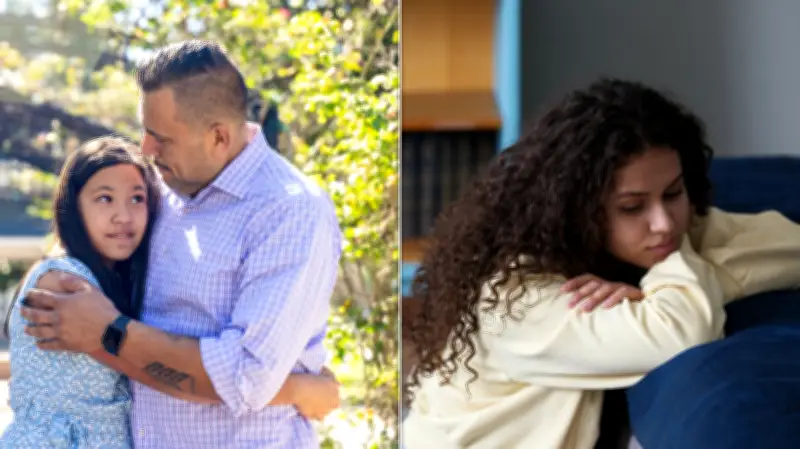
The term “father wound” describes emotional pain from an absent, emotionally unavailable, critical, unpredictable, or unsafe father figure, according to licensed marriage and family therapist Cynthia Flores. It can also stem from a father who was physically present but emotionally disconnected. The wound is about unmet developmental needs rather than blame.
How a Father Wound Forms
Psychotherapist Doriel Jacov notes that a father wound can form even when a father showed love in certain ways. “Many people I work with describe fathers who materially provided or were proud of them at times but struggled to emotionally attune or were emotionally unavailable,” he said. A constantly absent or critical father is not necessary for a father wound to form. “It often forms when a father’s love is present but also conditional,” Jacov said. “This unpredictability leaves a child anticipating when the next rejection will come and trying to avoid it.”
That mix can make the pattern harder to recognize. “It’s important to consider nuance when it comes to a father wound because the relationship might have included both warmth and hurt,” Jacov said. “The existence of both often makes these patterns harder to recognize and work on.”

Signs You Have a Father Wound
You Feel Like You’re Never Quite ‘Enough’
A persistent sense of self-doubt or feeling like you have to prove your worth can be one sign. “Some common signs I see in clients include: chronic self-doubt or feeling ‘not enough,’ overachieving to prove worth, difficulty trusting men or authority figures, people-pleasing, especially with male partners or bosses, fear of abandonment or rejection, hyper-independence that masks deeper hurt, and strong reactions to perceived criticism from men,” Flores said. Jacov said this often stems from growing up in environments where love felt conditional. “Many unconsciously believe that if they can just achieve ‘enough,’ they’ll finally be enough,” he said.
You Overachieve or Feel Constant Pressure to Prove Yourself
For some people, the wound shows up through relentless striving and perfectionism. “It is the high achiever who has degrees, success, praise and still feels like she has not done enough,” Flores said. “If approval or warmth only came through performance in childhood, achievement becomes tied to worth.” Jacov described hyper-achievement driven by a father wound as someone who never lets themselves rest, even when things are going well. “For example, someone might receive positive feedback at work but immediately focus on what they could have done better, feeling anxious if they aren’t constantly productive. They might stay late at work because leaving earlier triggers the feeling of not doing or being enough. Internally, this creates constant pressure to perform — achievement becomes a temporary relief from a baseline of not feeling good enough rather than an opportunity to feel proud and satisfied.”
You Struggle with Authority and Criticism
Relationships with authority figures — or even minor feedback — can feel emotionally charged for people who grew up with unpredictable or critical fathers. “It is the person who shuts down during conflict with men in authority,” Flores said. “A boss gives feedback and it feels crushing. Not because the feedback is extreme, but because it activates old feelings of criticism or emotional withdrawal from a father figure.” Jacov notes that this dynamic often reflects early experiences with authority. “Both sides reflect a highly fraught relationship with authority figures — authority is either something to conquer or something to hide from.” Even small comments can feel deeply triggering. “When getting feedback, they might feel like a disappointment and believe the relationship is under threat,” he added. “Neutral feedback may feel like criticism, and constructive feedback may feel personal. Some might constantly worry over disappointing those in authority and feel pressure to constantly prove themselves. Others might be defensive and combative as an attempt to prove that they aren’t falling short in any way.”

You’re Drawn to Partners Who Are Emotionally Unavailable
Romantic relationship patterns are another place where these dynamics often appear. “In dating, it may show up as being drawn to emotionally unavailable partners. There is often an attachment layer underneath,” Flores noted. “For someone with anxious attachment, inconsistency can feel like chemistry — if a partner is hot and cold, it can trigger a need to chase or secure the connection. For someone more avoidant, emotional distance may feel safer because closeness was never modeled. The pull is rarely random; the nervous system is drawn to what it recognizes.” Jacov said people sometimes recreate familiar dynamics without realizing it. “When love was conditional growing up, people learn that the only path toward acceptance is by earning it,” he said. “In adult relationships, they might try very hard to avoid making any mistakes and, when they do, feel anxious that they’ve disappointed their partner. Some may stay in relationships where they’re frequently criticized and emotionally unsupported, largely because those dynamics mirror the conditional love they know from childhood.”
You Struggle to Rely on Others
Another sign of a father wound is extreme emotional self-reliance. “It can also look like hyper independence. ‘I am fine. I do not need anyone,’” Flores said. “On the surface, it looks strong. Underneath, relying on someone feels unsafe because emotional support was inconsistent or unavailable early on.” Jacov said this can be a way of protecting oneself from vulnerability. “Underneath the avoidance also exists low self-worth, as it’s easier to avoid intimacy than to risk being rejected,” he explains.
You Fear Rejection and Abandonment in Your Relationships
Fear of abandonment is a common theme for a father wound. “It is the woman who spirals for hours because her partner took longer than usual to text back,” Flores said. “Logically, she knows he is probably busy, but emotionally it feels like abandonment.” According to Jacov, others might be highly defensive as a way to avoid the discomfort of feeling unwanted or rejected. “When love was conditional in childhood, adults continue to believe they have to prove their worth in relationships,” he said.
How to Heal the Father Wound
“Healing starts with awareness and compassion. Instead of asking, ‘What’s wrong with me?,’ we shift to, ‘What happened to me?’” Flores said. She emphasizes the role of therapy in processing these early experiences. “Therapy that incorporates attachment work, trauma processing and inner child work can be powerful. Learning to identify triggers, build emotional regulation skills and develop secure relationships in adulthood helps repair what was missing,” Flores explains.
Grieving unmet needs — including the paternal relationship you never had — is another key step. “That grief work is often the turning point,” she said. “When people stop trying to earn love from someone who couldn’t give it, they begin building self-trust instead.” Outside of therapy, Jacov said, “healing the father wound is developing secure and healthy relationships with others, such as friends, colleagues and romantic partners. These allow one to rewrite relational scripts.” Eventually, he added, “someone with a father wound can begin to internalize the idea that they have nothing to prove, that love is not conditional and that vulnerability is a strength.”