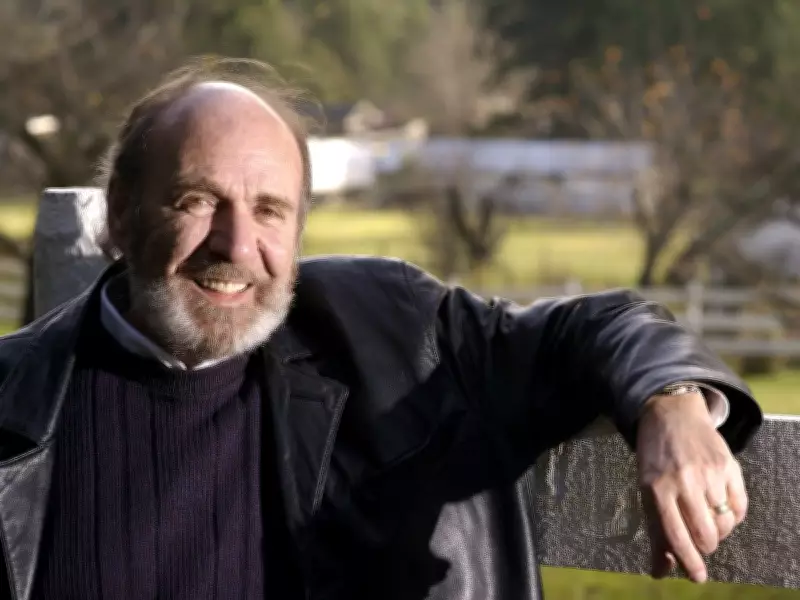
Sydney Banks: The B.C. Welder Whose Teachings Now Influence Global Health
The remarkable story of Sydney Banks, a former welder from Salt Spring Island with only a Grade 9 education, continues to resonate across continents. Despite his humble beginnings at the Harmac Pacific pulp mill, Banks developed a philosophical framework that has gained significant traction among healthcare professionals and therapists worldwide.
From Personal Crisis to Global Influence
During a profound personal crisis in the 1970s, Banks experienced what he described as a life-changing revelation. This transformative moment occurred during a therapy session with his wife on Cortes Island, where he suddenly realized his many insecurities were not real. Following this breakthrough, Banks couldn't sleep for two nights before having a mystical experience at a beach.
"I was literally shrouded in white light and I realized the true nature of God and mind," Banks recalled during his only mainstream media interview in 2007. "I realized life was a divine dream suspended in a place of time, space and matter." This experience marked the beginning of his journey as a wisdom teacher.

The Three Principles Philosophy
Banks developed a philosophy centered on three classic principles: mind, thought, and consciousness. His approach emphasizes that our external circumstances don't control our emotional state—our thoughts do. This perspective has been particularly embraced by the 3 Principles Global Community, a popular movement advancing his teachings.
Linda Pransky, an American leader within the 3 Principles Global Community, explains: "Through the principles of mind, consciousness and thought, Sydney revealed that the external world does not control how we feel—our thoughts do." This common-sense approach to emotional health bypasses traditional psychiatric methods and focuses on human resilience.
Global Reach and Practical Applications
Today, tens of thousands of people influenced by Banks live and work across Northern Europe, the United States, India, and Singapore. His teachings have found particular resonance among healthcare workers and therapists who use his approach to help individuals struggling with:
- Stress and trauma
- The effects of torture
- Drug addiction
- Extreme poverty
Remarkably, Banks—who died in 2009 at age 78—has become more influential posthumously than during his lifetime. Internet analysis suggests Canadians' interest in Banks remains relatively moderate compared to his international fame.
Legacy and Continuing Impact
The 3 Principles Global Community continues to organize events promoting Banks's world view, including a major conference scheduled for August at the University of British Columbia. Banks's journey from welder to philosophical teacher remains extraordinary, especially considering his educational background.
As Banks once noted with characteristic humility during his 2007 interview: "I realized, 'I made it. I'm home.' I knew this was going to change psychology forever." His teachings continue to offer an alternative perspective on emotional wellbeing that emphasizes innate human resilience over traditional therapeutic approaches.