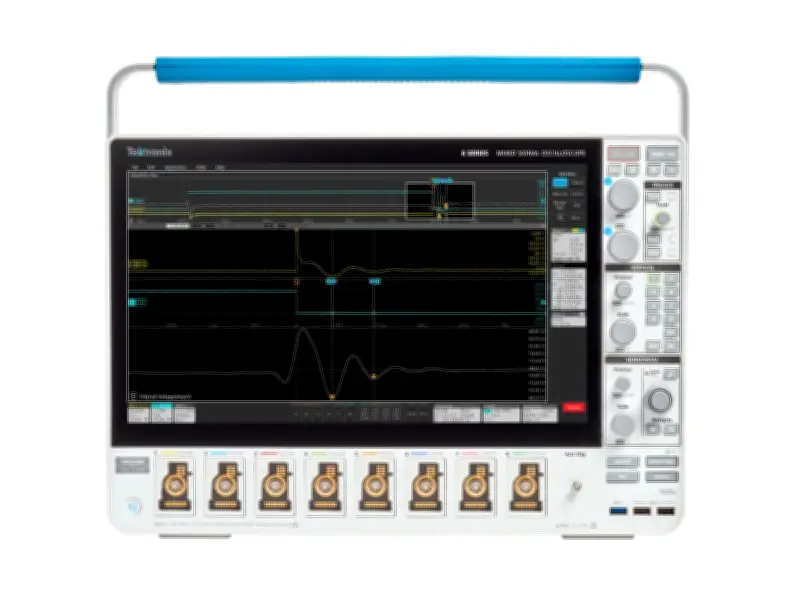
Tektronix today introduced its Power Distribution Network (PDN) Analysis Software for 4 Series B, 5 Series B, and 6 Series B Mixed Signal Oscilloscopes. By combining power integrity and signal integrity validation into a single workflow, the solution helps hardware designers evaluate power rail stability, identify sources of noise, and understand how power delivery affects signal performance.
Modern Electronics Demand Advanced PDN Analysis
The scaling of modern electronic architectures—specifically AI servers, high-performance compute, and advanced automotive electronics—fundamentally alters the demands on power distribution networks. Delivering fast-changing currents of 1000 A or higher and tighter voltage tolerances, these modern power networks must respond to rapid transient step loads without causing bit errors on critical high-speed data links.
Historically, validation teams have diagnosed the stability of these PDNs using frequency-domain measurements on standalone vector network analyzers. While effective for small-signal measurements, these workflows cannot capture real-world performance under active, high-current load conditions. They also require engineers to access voltage regulator feedback loops, which are often inaccessible in modern designs.

SEPIA Methodology Embedded in Oscilloscope
Step-load measurements better reflect the dynamic conditions under which today's power distribution networks operate and do not require access to voltage regulator feedback. Building on the Stability Evaluation for Power Integrity Analysis (SEPIA) methodology pioneered by Picotest, Tektronix is the first to embed SEPIA directly into an oscilloscope, enabling engineers to evaluate power supply and voltage regulator behavior using real load-transient conditions without breaking control loops and modifying boards.
“The boundary between power integrity and signal integrity has become a primary bottleneck in hardware validation,” said Daryl Ellis, Vice President and General Manager, Signal Acquisition and Analysis Portfolio. “By bringing time-domain stability analysis into the oscilloscope, engineers can evaluate power distribution network behavior under real operating conditions and better understand how power integrity affects signal performance.”
Key Features of the PDN Analysis Software
The PDN Analysis Software consolidates critical validation methodologies within the oscilloscope interface, utilizing the instrument’s multi-channel architecture to support power distribution network validation.
- Large signal transient stability analysis: SEPIA extracts phase margin, damping characteristics, and equivalent electrical circuit models directly from a typical high-speed step load response in as little as 500 microseconds without breaking control loops or modifying boards.
- Native 2-port shunt-through impedance: Supports automated multi-channel 2-port impedance profiling from 10 Hz to 50 MHz using the internal function generator.
- Power-supply-induced jitter correlation: Cross-correlates periodic timing variations in high-speed serial waveforms directly with power supply rail noise, allowing designers to evaluate how power rail noise contributes to signal degradation.
- Noise spectrum and automated rejection measurements: Typically features 85 dB of automated Power Supply Rejection Ratio (PSRR) metrics to quantify regulator noise attenuation, combined with multi-channel spectrum analysis to isolate rail noise sources.
By integrating power integrity analysis natively into the oscilloscope, Tektronix aims to streamline the validation workflow for hardware engineers working on next-generation power distribution networks.