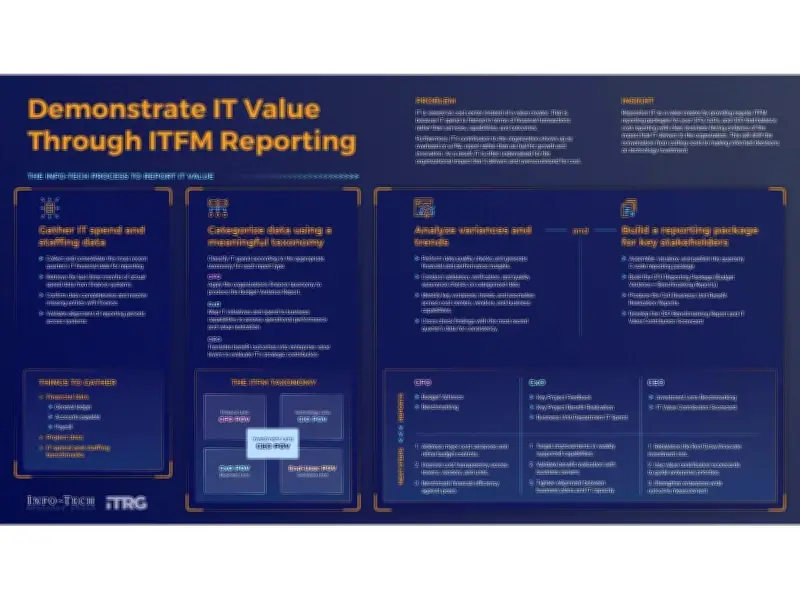
IT leaders face rising expectations to prove that technology investments deliver measurable returns, yet traditional IT financial management (ITFM) reporting often emphasizes costs rather than meaningful business outcomes, according to Info-Tech Research Group. The global IT research and advisory firm has released its Demonstrate IT Value Through ITFM Reporting blueprint to address this challenge, providing a practical, data-driven framework that connects technology spending to enterprise value and communicates it effectively to CFO, CxO, and CEO audiences.
Three-Phase Methodology for Executive-Ready Reporting
The blueprint’s three-phase methodology is designed to translate technology costs into business-relevant insights that executives can use to evaluate performance, make investment decisions, and assess organizational impact. By implementing this framework, organizations can improve technology investment governance, strengthen executive trust, and demonstrate measurable returns through role-specific financial reporting.
“Technology leaders can’t demonstrate value if every stakeholder is working from a different version of the story,” said Steven Nguyen, research analyst at Info-Tech Research Group. “Organizations need a unified reporting framework that connects technology investments to business outcomes and provides executives with the evidence required to make confident investment decisions.”

Three Key Principles of ITFM Reporting
Info-Tech’s blueprint identifies three key principles for effective ITFM reporting:
- Unify the story. A single reporting framework aligns definitions, data sources, and narratives across CFO, CxO, and CEO stakeholders, creating a consistent view of IT performance and value.
- Translate spend into value. Most spend data is organized for accounting, not decision-making. Standardized taxonomy and value metrics help organizations connect costs to services, projects, outcomes, and value levers while creating feedback loops that improve IT credibility over time.
- Report for executive decisions. A repeatable, role-specific reporting method enables the CFO, CxO, and CEO to evaluate performance, understand trade-offs, and make informed decisions about investments.
Bridging the Gap Between IT and Business Strategy
As technology investments face increased scrutiny, many organizations still rely on IT financial reporting models that emphasize spending without clearly demonstrating outcomes. This disconnect often reinforces the perception that IT is an operational expense rather than a strategic value creator, according to Info-Tech Research Group. The new blueprint aims to bridge this gap by providing a framework that links costs, benefits, outcomes, and value in an executive-ready format.
The framework is designed to help IT leaders shift the conversation from cost containment to value creation, enabling them to articulate how technology investments contribute to business objectives such as revenue growth, operational efficiency, and competitive advantage. By adopting this approach, organizations can move beyond traditional ITFM reporting and build a stronger case for technology as a driver of enterprise value.