The BC Government's announcement that BC Hydro is actively examining two new large hydroelectric dam projects is a dramatic acknowledgment that the province's electricity needs are far greater than previously admitted, according to the Energy Futures Institute.
New Dams and Return to Natural Gas Expose Flawed CleanBC Assumptions
“For years, British Columbians have been told that we have an abundance of electricity to support widespread electrification of transportation, buildings and industry,” said Barry Penner, KC, Chair of the Energy Futures Institute. “But now BC Hydro is studying two new mega-dams and going back to natural gas-generation to meet peak demand. This is a stark admission that fundamental assumptions behind the CleanBC policy were off the mark.”
The BC Government announced that BC Hydro will study the feasibility of two major hydroelectric projects: the proposed Site E project on the Peace River and the proposed Homathko project near Bute Inlet. Together, the projects could provide more than 1,600 megawatts of new generating capacity and produce roughly 6,000 to 7,500 gigawatt hours (GWh) of electricity annually, according to preliminary BC Hydro estimates, but likely take more than a decade to consult with the public and First Nations, obtain permits and financing, and complete construction.

Mixed Signals about Natural Gas
This announcement comes just weeks after BC Hydro advised the BC Utilities Commission (BCUC) that they need to reverse plans to phase out gas-fired generation at the Island Generation facility in Campbell River and the McMahon Generating Station in Taylor for approximately 400 megawatts of combined dispatchable capacity while also identifying a future need for additional dispatchable resources to meet winter peak demand by 2030. After extensive media coverage, BC Hydro later issued a “clarification” stating it was not currently pursuing new natural gas peaking plants but did not specify how the identified peak demand gap would be addressed. Then last week at a BCUC workshop (p. 255), BC Hydro stated there are few other options for reliably meeting future winter peak electricity demand.
It’s Policy, More Than LNG, Driving the Squeeze
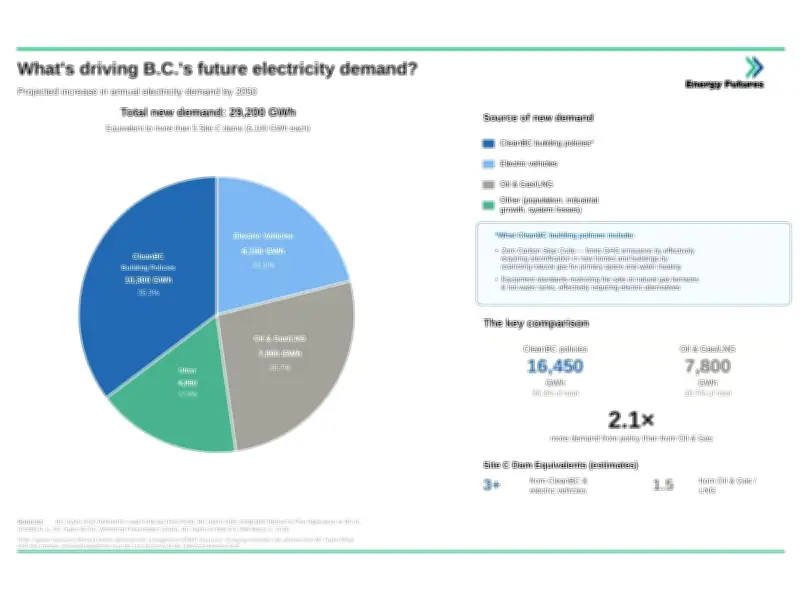
“A significant portion of future electricity demand, which government is now scrambling to address, originates from BC Government policy itself,” says Penner. “BC Hydro’s own analysis indicates that building-sector electrification policies alone could require two Site C dams worth of additional electricity production by 2050. When projected electric vehicle demand is included, that increases the need to three more Site C dams.”
In documents (p. 2-37) filed with the BCUC, BC Hydro estimated that province-wide implementation of the Zero Carbon Building Code and equipment standards restricting the sale of natural gas space heating and water heating equipment, as called for in the 2021 CleanBC Roadmap, will increase annual electricity demand by 10,300 gigawatt-hours (GWh) by 2050. BC Hydro has separately estimated that electric vehicles could add a further 6,150 GWh of demand by 2050. Combined, these government policy-driven measures would increase electricity demand by approximately 16,450 GWh annually by 2050 — equivalent to more than three Site C dams (the $16 billion Site C dam can generate 5,100 GWh annually under normal water conditions, whereas a dam at Site E on the Peace River is thought to be capable of generating 3,000 GWh annually). By comparison, BC Hydro’s updated February 2026 Reference Load Forecast projects that electricity demand from the oil and gas sector, including LNG (p. 21) will increase by approximately 7,800 GWh between 2025 and 2050. This means the projected increase in electricity demand associated with CleanBC building and transportation electrification policies is more than twice the anticipated increase in demand from the Oil and Gas sector, including LNG.