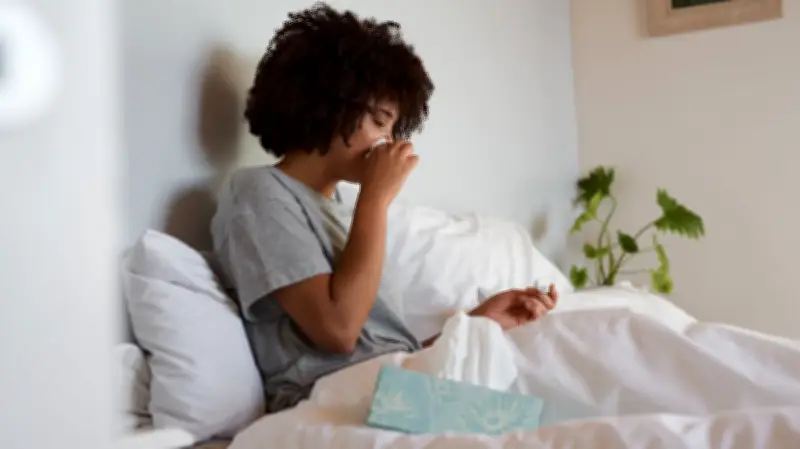
Did you come down with a nasty bug or a mystery illness recently? If so, you are likely one of many who has been targeted by a round of spring viruses. According to the public health Substack 'Your Local Epidemiologist' and data from the Centers for Disease Control and Prevention, the number of common colds peaked in the United States in mid-May.
Dr. Ashley Drews, an infectious disease specialist at Houston Methodist in Texas, said this pattern is also reflected in the data locally at Houston Methodist, which 'typically mirrors what is going on in the U.S.'
Rates of cold-causing viruses like rhinovirus and enterovirus are currently on the decline, but levels still are not at their lowest. They are predicted to drop more as we move into the summer months, but this pattern could explain why you have been sick recently, even though the weather is getting warmer across the country.

Understanding the Spring Peak
'There usually is a spring peak of the rhinoviruses — colds — and it is always very confusing to people because spring is also when you also get this avalanche of pollen happening,' said Dr. Jill Foster, a professor at the University of Minnesota Medical School.
While it is hard to tell the difference between allergies and a cold, Foster said there are a few things you can keep in mind. Allergies do not cause fevers, and antihistamines (like Zyrtec and Benadryl) 'tend to make allergies a little better, and antihistamines really have almost no effect on colds.'
If you are experiencing symptoms like congestion, a runny nose or tiredness in combination with a fever, you likely have a cold. 'And then there is also the combo of you have allergies and a cold, because there is no reason you cannot have both,' Foster added.
If you do not feel well and are not sure if it is a cold or allergies, it is best to stay away from other people, Foster added.
Rates on the Decline
Rates of rhinovirus and enterovirus, the viruses that commonly cause colds, are declining throughout the country. Good news: Most viruses will decline in the coming weeks, including colds. You can reasonably expect to see fewer cases of colds in the coming months.
'There is seasonal variation ... I think part of the reason that we see the seasonal variation now is related to the school year,' Drews said. 'Most kids got out of school last week, or maybe the week before, and not having children so close to each other reduces the spread of respiratory viruses.'
'That is one of the major reasons that we are seeing a reduction, but we seasonally have always seen some reduction of the rhinovirus in the summer that is not fully explained,' added Drews.
Foster added that most people spend more time outside in the summer. Illnesses, generally, spread more easily in indoor environments. More, with vacations, there are fewer people in office environments, she said, which can be an environment for virus spread, too.
'The other peak for cold happens in the fall, and it is because everybody then goes indoors, there is more people at work, people go to schools, the kids pick up something at school and bring it home to the rest of the family,' Foster said.
Protecting Yourself This Summer
You should still take steps to protect yourself, even if it is warm outside. Just because we are past the peak of the common cold does not mean you are safe from coming down with the illness.
'It has not gone away completely, and we are still seeing circulation,' Drews said.
To protect yourself from colds this summer (and all year), hand-washing is paramount, according to Foster. If you are out in public and touching door handles, light switches, railings and the like, you should be frequently scrubbing your hands. You should also always wash your hands before you eat or touch your face, Drews said.
It is also a good idea to avoid people who are coughing and sneezing, Foster noted. If you are sick, you should stay home so you do not spread germs to others.
For most people, a cold is just an annoying illness you have to navigate for a few days, Drews said. However, for kids with asthma, immunocompromised folks and those with underlying conditions, it can be a serious infection. This makes it doubly important to stay home if you are ill.

Prioritizing healthy habits such as getting enough rest and drinking enough water can also help protect you from getting ill, according to Drews. If you do notice a scratchy throat or runny nose, it is best to treat bothersome symptoms with medication and drink plenty of fluids. That way, you can rest up and get back to enjoying the summer in no time.