For Montreal columnist Josh Freed, the path to winter fitness took an unexpected and arduous detour through a maze of 45 screws, 20 major parts, and instructions written in microscopic print. What was advertised as an "easy to assemble on your own in under 30 minutes" stationary bike became a multi-day, physically taxing project that delivered a workout long before the pedals ever turned.
The Siren Song of a Simple Assembly
Faced with a snowy winter that made outdoor biking hazardous, Freed decided to take advantage of a Black Friday sale and purchase a stationary fitness bike. The promise was alluring: while many models reportedly take five hours to assemble, this one guaranteed a solo setup in under half an hour. "So I figured I could manage it in a couple of hours," Freed wrote in his December 27, 2025 column for the Montreal Gazette.
This was no small commitment for a self-professed non-handyman. "Construction isn’t my specialty. Destruction is," he admitted. He describes his fine motor skills as akin to "a penguin’s flippers" and his mechanical instinct comparable to "a bear handed a fishing rod." Friends know him as "Mr. Don’t-Fix-It," because repairs in his hands typically lead to greater breakage.

A Puzzle of Epic Proportions
The reality arrived in a giant box. Initial success with Step 1—releasing the bike frame—quickly gave way to despair at Step 2. Instead of a handful of pieces, Freed was confronted with over 20 major components, 45 screws, nuts, washers, and a tangle of electronic wires. The fasteners were sorted into plastic containers with labels like "#37 square neck bolt M862 X4 plus cap nut M8S13 X4."
The fundamental challenge was visibility. "Even wearing my glasses, with the room lights on, in broad daylight, my aging eyes couldn’t see these minuscule letters clearly," Freed recounted. He resorted to using his phone’s flashlight to decipher the manual, which read like a cryptic menu: “Lock seat cushion #72 to welded seat #80 with hexagon socket pan head bolts #12 and washer #71.”
The physical assembly was its own trial. Parts weighing over 10 kilograms required one hand to hold, another to fasten, and a mythical third hand to position washers. The result was a symphony of failure: washers and bolts repeatedly dropped to the floor, rolling under furniture, sending Freed crawling on his stomach with his flashlight, his "favourite tool," in search.
An Unlikely Path to Fitness
Salvation arrived 90 minutes in when a friend dropped by and volunteered to help. Together, they tackled steps like "Push umbrella handle knob #77 through washer #76." The collaboration, however, only slightly improved efficiency. "So I only dropped the washers another 10 times instead of 20," Freed noted. After over five hours of collective work, they had assembled only a quarter of the bike.
Freed persevered alone for another four hours, during which the 15-kilogram main frame fell on his foot, leaving him with a sore toe to match his aching head. Online assembly videos proved useless—a "quadruple-speed blur" of parts and arrows. He now faces a dozen leftover parts and a mix-up of nuts and bolts, though the contraption is beginning to "dimly resemble the online picture."
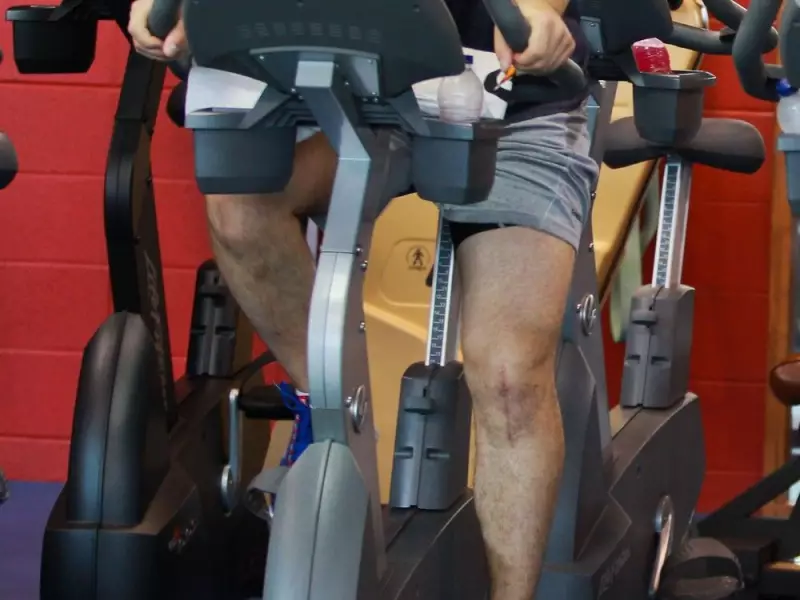
In the end, the bike is ironically serving its purpose. "Between crawling around searching for washers and lifting the heavy main frame 50 times, I’m getting plenty of exercise from my exercise bike," Freed concluded. He estimates the assembly workout should sustain him until real biking season returns in the spring. The column, signed off with a "Happy new year, all!" stands as a testament to the universal struggle against DIY promises and a reminder that the journey to self-improvement is often messier than the instructions suggest.