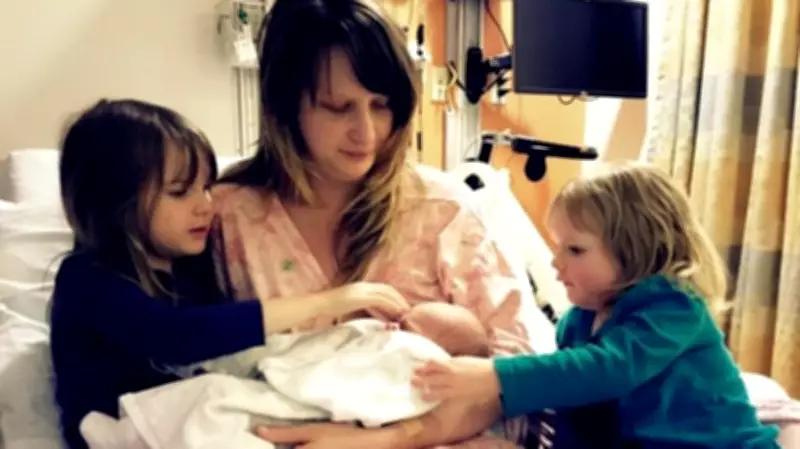
Four years after her youngest child was born, the author lay on an exam table while a doctor pressed his fingers into the gap between her abdominal muscles. He measured the width and depth, calling it severe. When she did a full sit-up, he paused her at the top and exclaimed, "Wow, look at that coning!" as if the strange dome her stomach formed was a roadside attraction. He asked about her fitness routine. She proudly mentioned attending at least three power-lifting classes per week and training to become an instructor. "You could do a million ab exercises," the doctor told her. "You could be the most fit person on the planet. It wouldn't change a thing."
She had known for years that she had diastasis recti, a condition that naturally occurs in the third trimester of pregnancy when the abdominal muscles separate to make room for the fetus. For 45–60% of postpartum women, the muscles fail to return to the center and seal correctly after birth. One study showed that 30% of women have mild abdominal separation for up to 30 years postpartum, while 10% have a long-lasting, more severe separation. She was among the latter. Her main symptom was back pain. Over time, diastasis recti can cause incontinence, overall weakness, and hernias.
The doctor told her that surgery was the only fix: an abdominoplasty, or tummy tuck. But insurance wouldn't cover it because it was considered "cosmetic." Dr. Frank Agullo, a plastic surgeon in Texas, explained that even though diastasis recti and loose skin can majorly impact daily living activities—like carrying children or sleeping through the night—insurance companies call it cosmetic because there is no imminent medical danger. "The fascia is intact, nothing is pushing through. The muscles have just separated, and the belly bulges out like a hump. Repairing it improves back pain, posture, core strength, and urinary incontinence in many of my postpartum patients," he said. "So the insurance companies ignore all those health impacts, focusing only on the flattening and contour of the tummy."

"If I don't have the money, I just have to live like this?" she asked her doctor. He nodded apologetically and shrugged. As soon as she left, she booked a consultation with a plastic surgeon.
She had already been considering a tummy tuck for years because her first two pregnancies left her with loose skin on her abdomen that felt sensitive and thin. For the last half of her 20s, she wore high-waisted, soft, stretchy pants to reduce direct pressure on her midsection. In summer, a heat rash formed if a band of fabric pressed against her extra skin. Sundresses became her whole vibe until the season changed.
With the skin problem alone, she was perpetually uncomfortable but too afraid to commit to surgery. Plastic surgery is safer than it used to be, but abdominoplasty has a higher mortality rate than operations like breast implants or facelifts. She had endured the sudden death of her father when she was 15, and she didn't want to risk putting her kids through the nightmare of losing a parent during childhood.
But after her last birth, the back pain was relentless, and her core weakness impacted every area of her life. She upped her workout schedule, assuming she needed to be more intentional about building muscle. It helped her confidence, but the center of her body continued to ache and feel wobbly. Eventually, she slipped a disk while lifting her older child. She gritted her teeth through the pain, meal-planning, and all the domestic work required to keep a family safe and running. She also worked full-time as a speech pathologist in an elementary school, requiring her to be quick on her feet. Month by month, she felt increasingly worse. Then, the state of her body started to affect her mood. She didn't feel as peppy or playful, and that wasn't fair to her kids. "The way my back and core feel hijacks my attention," she told her plastic surgeon. "It's making me a bad mom."
He patted her hand and listened to her litany of fears about anesthesia and recovery. He described the procedure in thorough detail, his voice gentle. She didn't feel pressured, and she was grateful that she needed to save up for the surgery. It would give her time to sit with the risks, rewards, and financial cost of the decision.

She finally went for it when she had set aside enough cash to pay for the procedure up front, completely worn out from trying to manage the constant discomfort. She didn't feel like herself, and after consulting with multiple specialists, an out-of-pocket tummy tuck was truly the only option. "It's almost like building a corset inside your body," said Dr. Shim Ching, a plastic surgeon in Hawaii. "We're essentially making a low, horizontal incision, lifting up the skin, exposing the muscles, and I go in and tie them together. We can repair those muscles back to where they should be." He explained that there are no other options that address both the skin and the muscles in a functional way.
The day of her pre-op appointment, the plastic surgeon drew on her abdomen with a purple marker, showing the skin he'd remove. "We'll have to take off your belly button," he said. Her mouth dropped open. He handed her a book of belly buttons he had designed for his previous patients, photographed at various stages of healing. "Time to go shopping," he said. Throughout the experience, she had cared very little about aesthetics. Her first pregnancy brought thousands of stretch marks, and a tummy tuck came with an enormous scar, hip-to-hip. She knew she'd never look 20 again, and she didn't want to. Other than the sensitive skin and core issue, she liked how pregnancy had changed her body. But now she had to think about what she wanted her belly to look like. She touched the pictures of belly buttons and told the doctor she had no idea. "I suggest a soft oval," he said, flipping until he found a healed, ovular image. He tapped it. "Very popular." "Soft oval it is," she said, shutting the book.
The next morning, she arrived an hour before surgery so he could redraw his purple lines. She put her hair in a bun, shoved it into a sterile shower cap, and changed into a robe, flimsy paper underwear, and grip socks. A nurse led her into the surgical suite, helped her climb onto a table shaped like a lowercase "t," arms out. She placed a heated plastic blanket over her body, inserted an IV, covered her mouth with a mask, and she was out. When she woke up, her left shoulder hurt more than anything else. "The gas we use irritates a nerve that's connected to your shoulder," the recovery nurse told her. Nothing she gave her dulled the unexpected shock of pain. She felt vulnerable, regretting that she had paid someone to chop her body into pieces and sew it back together, but she didn't break down until it took three tries to slip on her sandals. "You built three brand-new human beings," the nurse said, rubbing her back. "It tore you up. Now you get to heal, for real."
Her shoulder pain abated within hours. The doctor had threaded localized painkillers throughout her abdominal muscles, so even though she walked with a hunch, the pain in her abdomen was mild for three days, only moderately sore after. It took about six months for her to stand fully straight. Her only complication was a wicked bout of COVID a few weeks after surgery that she thought would split her in half. "Hold a pillow against your tummy when you cough. You'll be fine!" the on-call nurse said in the middle of the night, and she was right.
In her youth, she knew little about plastic surgery, thinking it was indulgent at best. After going through it, she believes it should be offered to people with birth injuries by default. Research has shown for years that the emphasis on beauty for U.S. women creates mental health issues, gaps in career potential, and plenty of other medical problems. Even if abdominoplasties really did only address repairing physical damage to a woman's appearance from childbirth, in a country like the United States, providing them postpartum seems like ethical healthcare. But the pain and discomfort after carrying and delivering a baby are real medical diagnoses. Insurance companies will prescribe painkillers for decades to treat the back problems caused by diastasis recti, for example, but not pay to repair the separation itself.
It has been five years since she hobbled out of that recovery room, terrified that she had made a selfish and risky choice. Now, she believes going through with the surgery is one of the best decisions she ever made. As she recovered, she realized how much her separated abs had impacted her overall posture and comfort with even leisurely activities like going on a walk. Surgery and recovery were a huge ordeal, but she did feel better and stronger every week. Her lower back pain is gone, and her core feels solid. Without the constant haunt of discomfort, she has been a far more present mother. She takes her kids on vacation at least once a year and lifts her daughter in and out of theme park rides without a problem. The bonus, of course, is her ovular belly button. She never really looked at that part of her body before, but she kind of loves it now. When she notices it in the mirror, it reminds her that sometimes it's worth taking a taboo risk that feels right for your body, even if people might judge you for it.