My wife Rebecca and I marked our 26th wedding anniversary while she was receiving inpatient care at a hospice center for pain management due to her colon cancer. "Celebrated" might not be the perfect word, though we certainly made an effort.
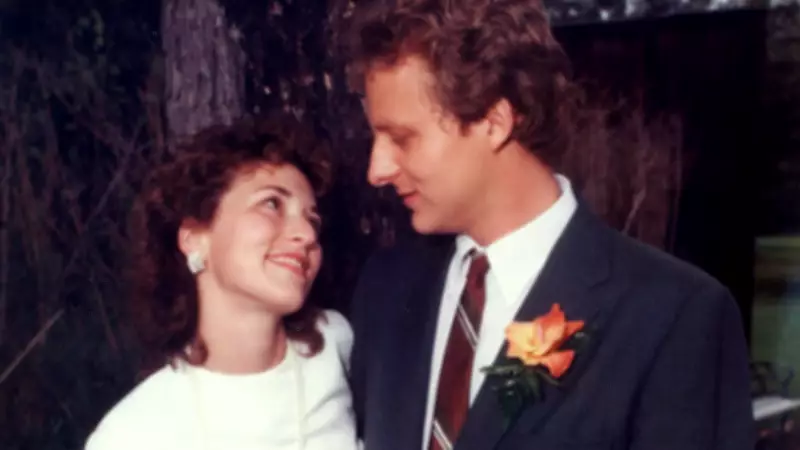
On that day, I dressed up a bit and brought her an elegant blue dress, photos from our unconventional wedding, and a bottle of her favorite Barbaresco wine. After consulting with her doctor, I wheeled her in a chair to the garden to enjoy it. It was a sunny Friday during a warm Labor Day weekend. The Prairie Memory Garden was bursting with late summer blooms, and a playful pair of blue butterflies joined our bittersweet gathering.
Rebecca felt slightly less miserable, so after we shared wedding memories, she reminded me of what she expected of me as she envisioned my life without her. She wanted me to support our daughters as much as I could, emotionally and financially; to remember her with love but not sadness; and not to fall apart or be afraid to love again — because despite the pain, it would be worthwhile.

"Please, not today," I said, taking her hand and kissing her pale cheek. "It's our anniversary!"
"I know, but you've had a rough couple of years, too."
"Nothing compared to you, and you've said all of this!" Rebecca had indeed told me all of this dozens of times. She had been confronting death for nearly three years — since we learned the cancer had spread to her lungs and was almost certainly fatal.
We had recently visited MD Anderson in Houston for a second opinion. When asked about potential treatments, the experts there said there was "nothing on the horizon anytime soon."
We had been married in Houston at the Rothko Chapel, and we stopped there after the appointment. We sat silently together, holding hands. The great artist's haunting purple canvases had been part of both the happiest and most difficult days of our lives.
Now, we both knew this was our last anniversary together. Rebecca was just 53.
"Sorry, but I feel guilty about putting all of you through this," she said, taking a sip of her wine and putting her arm around me.
"Guilty for being sick?" I asked.
"Yes. The last three years have been hardest on you, but the rest will be hardest on the girls," she said. "You'll find someone new, but they're losing their mother."
She had a determined look and moved her arm away. "Even if you meet someone here at the hospice, stay open to it! Just find someone the girls like."
"Damn it, stop!" I said, raising my voice slightly. It was all too much. "Please!"
Her lungs were full of tumors, and she required oxygen to breathe; at home, she would accidentally pull the tubes out in the middle of the night, waking us both in a nervous panic.
Rebecca had grown so thin that her skin took on a white, shiny porcelain look. Still, she was so strong and beautiful — and she was still thinking of others before herself, as she always had since I'd known her.
Rebecca had done fieldwork for her economics Ph.D. in the highlands of Ecuador, helping indigenous people obtain land titles for credit. Later, she worked for the U.N. in Rome and consulted in Africa and South America. Even in her last year, she had done extensive training with the Red Cross to assist people displaced by fires. And with her dear friend Deb and me, she had even picked out the spot for her memorial bench along a local creek conservancy.
Earlier in the week, before our anniversary, she had become delirious and thought she was going to act in a play later that night. Rebecca was determined to get up and dress for the evening, but she was far too weak. She humored me by letting me brush her hair until she finally got up to do it herself, dragging her oxygen tank into our master bedroom bathroom. Then she saw her reflection in the mirror.
"Do you see how sick you are, honey?" I asked.
She nodded with sad recognition, and I helped her back into bed.
The next day, she agreed to be briefly admitted to the inpatient hospice center for pain relief.

She felt a little better on our anniversary and had her wits back again, despite her battle with pain. Calming myself, I told her I loved her and thanked her for thinking of the girls and me. She smiled, and we returned to our wine. The cheerful, slightly sarcastic humor that had carried us through all our years together (especially the last three) returned. She teased me about my red wine mustache and the cheap green suit I had worn to our wedding. We toasted our years together.
Wheeling her back from the garden, I noticed a woman in her late 80s, struggling with a walker, heading into the hospice center.
"Oh, excuse me," I said to Rebecca, pretending to recognize the woman. "That's my new special friend, Bernice!"
Rebecca let out that honest, earthy laugh that I loved. It was the last time I heard it in all its glory.
She struggled through one more month. The morning her pain finally ended, I had bathed her and even put on perfume she liked. After days of incoherence, she startled me by suddenly observing, "That's not deodorant I smell!"
"You're right, that's the Vera Wang I got you for Christmas," I told her.
"That was a winner!" she cried happily. Those were her last words to me.
Later that day, my last words to her were to tell her she was the finest person I had ever met.
That afternoon, I sat at the memorial bench Rebecca had chosen with our two daughters on either side of me. We briefly held hands and closed our eyes. It was a discordantly beautiful October afternoon. The bench was beside a briskly bubbling creek with stepping stones to cross above a manufactured rapid. Just then, a mom, dad, and two young girls came tiptoeing over the creek, as we had done when our girls were little. We sat silently for a few more minutes, each lost in our thoughts and searing memories. The sun glowed through the fall leaves above the peaceful creek setting. Rebecca had picked the perfect spot for this moment and many more to come.
Condolences arrived from people all over the world: old colleagues in Rome, Ecuador, and Tanzania; friends from four continents; an elderly couple she had recently met at a fire; lives she had touched. We pulled off the complex memorial service, which Rebecca had planned in considerable detail. The service turned out well, but then the crowd was gone, and I was back to sleeping in the same bed, in the exact spot where she had struggled — and where she had at last found peace.
The bright sunny days of October turned into the gloomy gray skies of November in Wisconsin. I was in our house alone, surrounded by Rebecca's things and all of my memories. There were stacks of medical supplies, suddenly both conspicuous and useless; there was that tragically powerful hairbrush. I learned a lot about grief. It was easier to deal with her things — to store or throw them away — in the mornings when I was fresh, and I learned that things, however charged, were just things. I tried to schedule evenings to cry so that I would do it less at work, and I managed this with mixed results. The tears seemed to come from some inexhaustible spring.
Several sad months passed. I sometimes still cried at work, but I would turn my chair around to look out the window so that it was harder for others to see me. Those few who did see me were kind and supportive. I missed Rebecca terribly, but the girls and I made it through our longest winter.
In April, I received a call from Rebecca's close friend Deb, who had helped us pick out the spot for her bench. Deb told me that Rebecca had asked her to call me six months after her death to encourage me to get out and meet new people — including women.
Rebecca! Even after she was gone, she was still finding a way to show me how much she cared. She taught me so much about courage, compassion, and love. For her, love was a form of generosity. It was a way of seeing and valuing the other person from beyond the moment — even from beyond the grave. She saw how hard my life would be without her, but her love was not about jealous clinging — it was about helping to set me free. There's a profound truth in that.
As my fellow widows know, there is your life before the death of your beloved spouse and your life after. The pain never fully goes away. I still miss Rebecca. For me, grief is like weather, and a storm can rise up suddenly on even the sunniest day. The storm clouds always have a name and face.
It has been 10 years since Rebecca passed. I have been lucky to find another generous partner — and I have not felt a single second of guilt about moving forward with my own life because of the gift that Rebecca gave me.