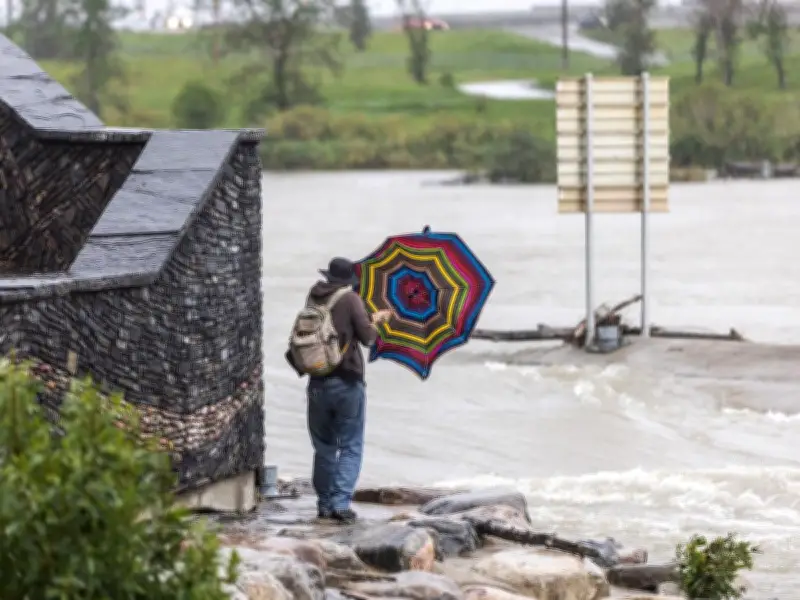
Parts of Calgary have seen between 75 and 100 mm of rainfall in the past 72 hours, but the soggy start to June is not abnormal for this time of year, according to meteorologists.
“June is often our wettest month in the Calgary area,” said Christy Climenhaga, a meteorologist with Environment and Climate Change Canada. June’s average rainfall is 112.7 mm, but it is not uncommon to see larger dumps over the course of a few days, she added.
Rainfall was expected to taper off Tuesday, with scattered showers throughout the day. “The system responsible for all of this rainfall that’s just kind of spinning in the area is starting to weaken, and we will see some relief,” Climenhaga said. “You’ll start to see some clearing and return to some quieter weather.”

Some rain is expected Thursday and intermittently through the weekend, but with less intensity than over the past few days.
Comparison to the 2013 Flood
Though the combination of a stalled low-pressure system and melting snowpack in the mountains is reminiscent of conditions that led to the 2013 flood, Climenhaga said it is “definitely a different ballpark.” In 2013, some areas along the river basins reported upwards of 300 mm, resulting in severe flooding that had not been seen along the Bow and Elbow rivers since 1932.
Disastrous flooding in June 2013 caused more than 110,000 people to be evacuated across 26 communities, left 34,000 locations without power, flooded 30 parks across the city, and shut down more than 20 bridges and 16 LRT stations. Across the province, damage, emergency response, and recovery costs were estimated at $5 billion, including $409 million in damage to City of Calgary infrastructure.
Bow River flow rates peaked at 2,400 cubic metres per second during the 2013 flood, while the Elbow River’s flow reached 1,240 cubic metres per second. Though flow rates for both rivers have been climbing over the past several days, the Bow’s flow has only reached 438 cubic metres per second within the city, while the Elbow peaked at 85.7 cubic metres per second. In Banff, Bow River flow rates peaked on Monday at 302 cubic metres per second — nearly three times the normal rate.
In a Tuesday statement, the City of Calgary said that widespread overland flooding is not expected, despite elevated water levels. “River flows continue to track as expected and will peak in Calgary this afternoon,” the statement said. “Some low-level pathways remain closed and there remains possibility of additional closures as river levels peak. Water may continue to pool in streets and catch basins.”
Since Saturday, the city has received 405 requests to clear catch basins and address ponding, and has responded to more than half. Call levels have been consistent with equivalent weather events, the city said.