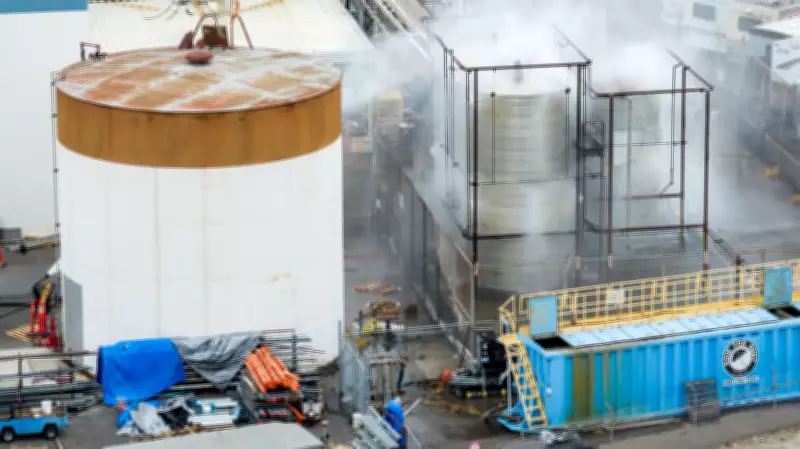
Authorities announced Monday that the risk of a catastrophic explosion at a damaged chemical tank in Southern California has been eliminated after an overnight inspection confirmed that a crack in the tank relieved pressure and cooled the chemical.
Overnight Inspection Yields Positive Results
Officials conducted temperature checks on the tank during the night to minimize risks to firefighters, avoiding daytime operations when heat from the tank made conditions most dangerous. Orange County Fire Authority division chief Craig Covey stated that the overnight mission allowed crews to verify the crack and confirm that temperatures were falling. He described the results as "incredibly positive news."
Despite the reduced threat, evacuation orders remained in place for approximately 50,000 people in Garden Grove, located south of Los Angeles. Covey noted that falling temperatures and pressure release were allowing officials to "turn the corner on this incident" after days of concern about a possible explosion.

No Chemical Leak Reported
As of early Monday, there was no chemical leak, but the Orange County Fire Authority emphasized that the risk to public safety is "ongoing." The tank, containing methyl methacrylate used to make plastic parts, overheated Thursday and began venting vapors. Firefighters have repeatedly sprayed the tank with water to cool the chemical inside.
The tank's interior temperature reached 100 degrees Fahrenheit (37.7 Celsius) on Sunday, an increase of 10 degrees Fahrenheit (5.5 Celsius) since Saturday, according to Democratic state Sen. Tom Umberg. By Monday, Covey reported the temperature had dropped to 93 degrees Fahrenheit (33.9 Celsius).
Emergency Response and State of Emergency
Gov. Gavin Newsom declared a state of emergency Saturday and requested President Donald Trump to issue an emergency declaration to bolster federal support. The tank at GKN Aerospace Transparency Systems holds 6,000 to 7,000 gallons (22,700 to 26,500 liters) of methyl methacrylate. The facility makes parts for commercial and military aircraft.
Firefighters' primary goal was to cool the chemical to prevent a leak or explosion. Drones monitored temperatures at 10-minute intervals, and containment barriers were set up to prevent chemical spills from reaching storm drains, creeks, or the ocean.
Expert Analysis on Explosion Risk
Purdue University engineering professor Andrew Whelton explained that as interior temperature rises, methyl methacrylate converts from liquid to gas, increasing pressure. He compared the situation to a soda can left in a hot car: "If you put a hole in the can, the product is released and the can itself doesn't explode." An explosion could spread the chemical over a broad area and send shrapnel flying.
Displacement and Health Concerns
Aerial photos showed empty streets in the area, with several evacuation shelters open. At a high school in La Palma, people slept in cars or on mats and sleeping bags. Garden Grove is next to Anaheim, home to Disneyland, which was not under evacuation orders. Park officials said they were monitoring the situation.
Exposure to methyl methacrylate can cause serious respiratory problems, neurological issues, and irritation to skin, eyes, and throat. Whelton emphasized the need for detailed air monitoring specifically for methyl methacrylate, rather than generic tests for volatile organic compounds, as done after the 2023 train derailment in East Palestine, Ohio. Orange County health officials noted the chemical is easy to smell and may be noticeable over a large area without causing harm.
Legal Action by Residents
Some Garden Grove residents filed a class-action federal lawsuit Saturday against GKN Aerospace Transparency Systems. Lawyers argued that regardless of the outcome, property values in the surrounding community would be impacted. GKN Aerospace did not comment on the lawsuit but apologized to residents and businesses forced to evacuate, stating it was "working around the clock to mitigate the risk of a leak." The company agreed in 2025 to pay over $900,000 to settle violations involving recordkeeping, permitting, and nitrogen oxide emissions, according to the South Coast Air Quality Management District.