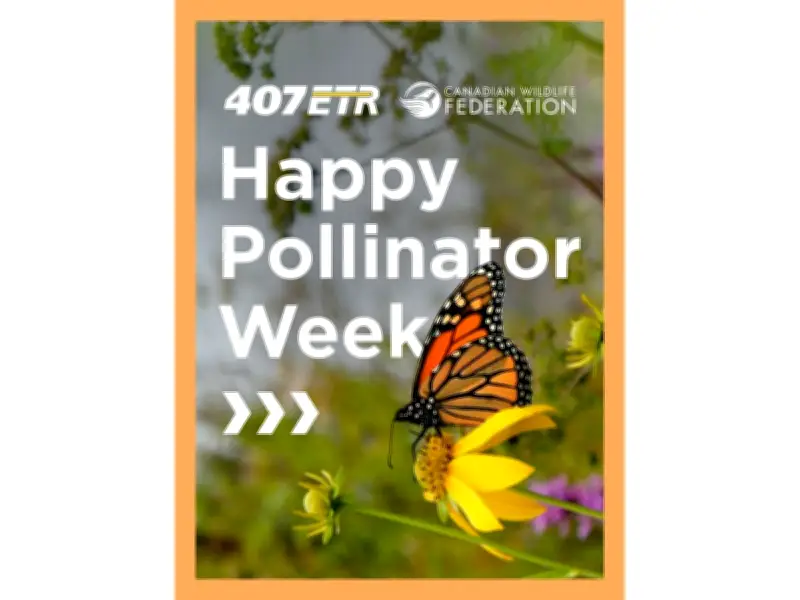
TORONTO, June 26, 2026 /CNW/ – 407 ETR is marking Pollinator Week by expanding its partnership with the Canadian Wildlife Federation (CWF) with a $2 million commitment over four years to restore and protect pollinator habitat in the Greater Toronto Area (GTA). The initiative includes native plant giveaways and community engagement efforts.
Expanding Successful Restoration Program
From 2023 to 2025, the program supported 15 restoration projects from Burlington to Bowmanville, restoring nearly 15 hectares across the GTA. Over the next four years, it will expand to 26 additional projects and 35 hectares, helping create and strengthen critical habitat for pollinators, including monarch butterflies and native bees. Combined, the sponsorship will ultimately support the restoration of 50 hectares of native meadow habitat for pollinators across the GTA between 2023 and 2030.
"The Highway 407 ETR corridor closely aligns with the monarch butterfly migration route," said Jose Espinosa, President & CEO of 407 ETR. "Through our partnership with CWF, we're not only restoring vital pollinator habitats in municipalities along the corridor — we're helping build healthier, more resilient ecosystems across the GTA."

Protecting Monarch Migration Routes
Monarch butterflies rely on native plants to fuel their annual migration between Canada and Mexico. The eastern population of the monarch butterfly has declined by more than 80% over the past 25 years. The partnership focuses on large-scale habitat restoration, conservation leadership, and community engagement to support this critical species.
"Pollinators connect us all," said Sean Southey, CEO of the Canadian Wildlife Federation. "407 ETR's sponsorship allows CWF and our partners to restore habitat, inspire conservation action and help people become part of the solution. We are grateful for 407 ETR's commitment to nature and excited about the difference that we can make together for monarchs, native bees, and the ecosystems that sustain us."
Community Engagement and Education
As part of this partnership, 407 ETR and the Canadian Wildlife Federation are expanding community engagement initiatives to connect people directly with conservation efforts. This includes native plant giveaways across the GTA to support pollinator-friendly gardening at home and the development of a Virtual Canadian Centre for Monarch and Pollinator Conservation Hub to broaden access to education and resources across the region.
GTA residents can support pollinators with native species for their gardens. Native plants have co-evolved with the wildlife of that area and are often their perfect food. They require less maintenance, are less susceptible to disease and pests, and many produce colourful blooms. More information is available at 407etr.com/monarchroute.
Fast Facts on Pollinators and Conservation
- There are over 200,000 kilometres of roadways in Ontario, representing tens of thousands of hectares of vegetated land with potential to provide pollinator habitat.
- There are more than 800 species of native bees in Canada, and 8 are considered at risk.
- The eastern population of the monarch butterfly has declined by more than 80% over the past 25 years.
Additional Conservation Efforts
407 ETR is proud to support pollinator awareness and education as a sponsor of Bees: A Story of Survival at the Royal Ontario Museum, on now until October. The new immersive experience explores the critical role bees play in our ecosystems with the beauty they provide through art.
The company is also funding a phytoremediation study with the Toronto and Region Conservation Authority (TRCA), Royal Military College, and Queen's University. The research is exploring the use of biotechnology and halophyte plants to remediate salt-contaminated soils and reduce the environmental impact of road salt application.
Since 2023, with the support of Trees for Life, over 60,000 native trees have been planted along Highway 407 ETR, helping restore habitat, improve air quality, and strengthen ecological resilience in surrounding communities.