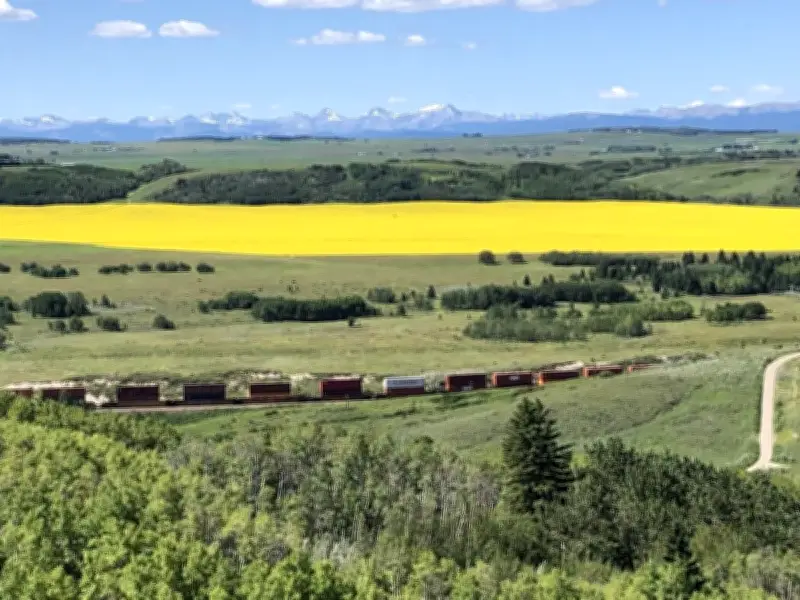
Alberta’s trademark big, blue skies are a constant companion on all these walks. When clouds roll in, the textures and patterns of the land juxtaposed with the blue backdrop draw your eyes high. Vast and open, Glenbow Ranch Provincial Park is situated along the north bank of the Bow River between Calgary and Cochrane in Rocky View County, offering 40 km of interconnecting paved and gravel pathways. Trains have travelled through this piece of prairie since 1883 as part of their cross-Canada trek.
Walking Routes Through Glenbow Ranch and Haskayne Park
All walks begin with a descent into the valley. Walks one and two follow the hilly western section of Glenbow Ranch Park through rolling grasslands, past aspen-filled coulees to boundless views of the Bow River Valley and the Rockies beyond. Walks three through five follow Glenbow Ranch trails east towards the Bow River and to Haskayne Park.
Historical Significance and Indigenous Heritage
When you walk here, you follow in the footsteps of Indigenous people who lived and hunted in the area. Evidence of teepee rings, cairns, and bison kills has been found dating back 11,500 years. It is believed that many of these were camps occupied by small family groups following bison herds across the plains. In 1881, Glenbow Ranch was part of the Cochrane Ranche, Western Canada’s first large-scale cattle ranch. Ranchers discovered their cattle could not withstand the harsh winters as the bison had, a lesson critical to the success of future southern Alberta ranches.

Working Ranch and Ecological Grazing
Cattle still roam the fields at Glenbow Ranch, as the park remains a working ranch. Grazing helps maintain the health and vigour of the fescue grassland landscape. In the fall and winter, the cattle eat the tall, protein-rich grasses. Their grass cropping allows sunlight to reach the roots, leading to healthy grass growth in the spring.
Sandstone Quarry and Brick Factory History
In 1905, when Alberta officially became a province, there was an immediate demand for stone for government buildings like the legislature, courts, and universities. Glenbow became one of many sandstone quarries around the province to supply building materials. A townsite developed with a store, post office, school, and railway station. When building was complete, the quarry shut down in 1912. Shortly after, a brick factory was established near the Glenbow store, employing many former quarry workers. The Glenbow brick operation was strategically located between the quarry pit (source of clay) and the Bow River (water source), and close to the railway for transport. The brick-making operation did not last long and was abandoned just before the First World War. The stone and brick productions made Glenbow popular until 1920, when the once-vibrant community turned into a ghost town.
Park Creation and Modern Use
Glenbow Sheep and Horse Ranch remained private until 2006, when the Harvie family and the Government of Alberta created what would officially become Glenbow Ranch Provincial Park. Today, the park offers unspoiled views of the pond, river valley, rolling hills, and wildflowers, providing a serene escape for hikers and nature enthusiasts.