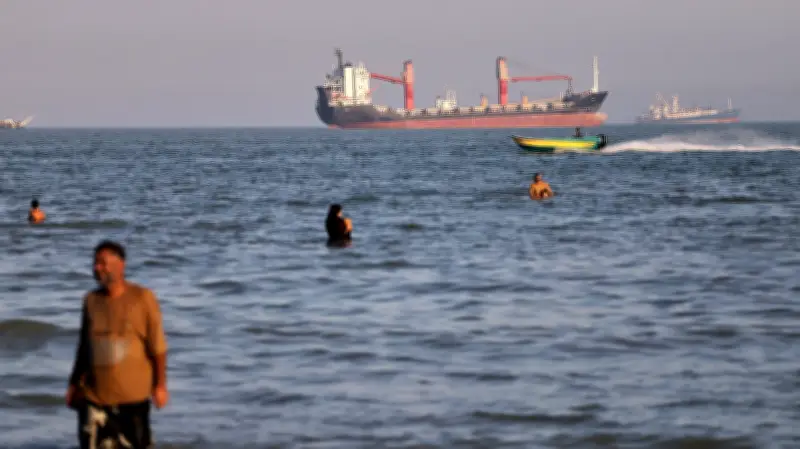
A Liberian oil tanker, the Stoic Warrior, successfully transited the Strait of Hormuz on Thursday using a newly promoted route close to Oman's coastline, defying threats from Iran's paramilitary Revolutionary Guard. The voyage occurred amid rising tensions between Iran and the United States over the terms of an interim accord aimed at ending the Iran war, and as regional conflicts in Lebanon and the Persian Gulf continue to escalate.
New Route and Iranian Warning
The Stoic Warrior departed early Thursday along the coast of the United Arab Emirates and Oman, traveling around Oman's Musandam Peninsula near the shore. This route was laid out by Oman in coordination with the International Maritime Organization (IMO), a United Nations agency overseeing maritime shipping. The traditional Traffic Separation Scheme, located in the center of the strait and used for transporting about a fifth of the world's oil and natural gas, has been shut down due to the threat of mines. The Revolutionary Guard claimed to have mined the passage after U.S. and Israeli strikes on Iran began on February 28.
In response to the new IMO route, the naval arm of the Revolutionary Guard issued an angry warning on Thursday, as reported by Iran's state-run IRNA news agency. “A few hours ago, without notice or coordination with the Islamic Republic of Iran, some authorities announced a new route for ship traffic in the Strait of Hormuz, which is unacceptable and completely dangerous,” the Guard stated. “It is hereby notified to all that the only authorized route for passing through the Strait of Hormuz is the one declared by the Islamic Republic of Iran. Vessel traffic outside these routes is extremely dangerous and prohibited.” The Guard added that “violators will be dealt with,” without elaborating on the consequences.

Despite the warning, no incidents were reported as the Stoic Warrior passed through the strait, with several other ships trailing behind, according to ship-tracking data. Anwar Gargash, a senior Emirati diplomat, warned Iran on Thursday against attempting to impede the strait or impose fees on vessels. “New geopolitical facts cannot be imposed on the Arab Gulf states as a result of a treacherous aggression against them,” Gargash wrote on X. “It sows new seeds of discord and conflict for the future. And this is precisely what applies to the Strait of Hormuz.”
U.S.-Iran Deal and Regional Diplomacy
The transit of the Stoic Warrior comes as the United States and Iran debate the terms of a memorandum of understanding signed last week, which includes a 60-day period to iron out details such as the future of Iran's highly enriched uranium stockpile and the safe passage of ships through the Persian Gulf. Both countries are negotiating in public and private, raising the risk of derailing the shaky ceasefire in the region.
U.S. Secretary of State Marco Rubio traveled to the Middle East and met with Gulf Arab officials in Manama, Bahrain, on Thursday to assuage their concerns. The island kingdom is home to the U.S. Navy's 5th Fleet. Rubio met with foreign ministers from the six-nation Gulf Cooperation Council (GCC), assuring them that their interests would be protected in any agreement with Iran. “We want to ensure that in any decisions that are made throughout this negotiating process, the interest of our partners and our allies in the region are always taken into account,” Rubio said. “There is no part in this deal that’s undertaken that in any way undermines the security, the stability of the prosperity of any of our partners in the Gulf region.”
GCC countries have expressed reservations about the U.S.-Iran deal, citing conflicting claims over the Strait of Hormuz and the fact that the memorandum does not specifically cover Iran's nuclear or ballistic missile programs. Thursday's meeting preceded an expected meeting in Oman between the GCC and Iran to discuss maritime security and safety in the strait. Bahrain's Foreign Minister Abdullatif bin Rashid al-Zayani thanked the U.S. for its support, saying that because of the agreement, “today we see a glimmer of hope for our region,” but stressed that Iran must comply with its commitments. “While this progress is encouraging, it is critically important that Iran adheres to its obligations,” al-Zayani said.

Lebanon Remains a Flashpoint
The flareup of fighting in Lebanon between Israel and the Iranian-backed militia Hezbollah has threatened the deal. On Wednesday, Israel launched an airstrike that killed two people in southern Lebanon, according to the country's state-run news agency. It was Israel's first airstrike on Lebanon since a ceasefire took effect on Saturday. Israel's military reported on Thursday that a reservist soldier was killed and another wounded in southern Lebanon, where troops are occupying swaths of the country. At least 37 soldiers have been killed in Lebanon or northern Israel during the fighting, as well as one civilian defense contractor. Two civilians in northern Israel have also been killed.
Over 4,000 people in Lebanon have been killed in Israeli strikes since the latest Israel-Hezbollah war began in March, two days after the Iran war started and when the Lebanese militant group fired at Israel. Iran has insisted that fighting in Lebanon be stopped and that Israel give up the land it occupies there to reach a permanent deal with the U.S. on the Mideast war. Israel insists it must maintain a free hand to counter Hezbollah attacks as pressure from the U.S. on its campaign grows.