It felt like a tire was going flat. The truck wasn't tracking straight, the steering felt wobbly, and I was losing power as if something was dragging behind. But then, everything returned to normal, and I rattled along with gravel dust trailing. It wasn't a flat tire; I had just hit a long patch of soft road.
There were plenty of such patches on the side roads along the Rosebud River, which was a good sign. It meant plenty of water lay just below the surface, great for growing crops, and that most previously dry sloughs now held water.
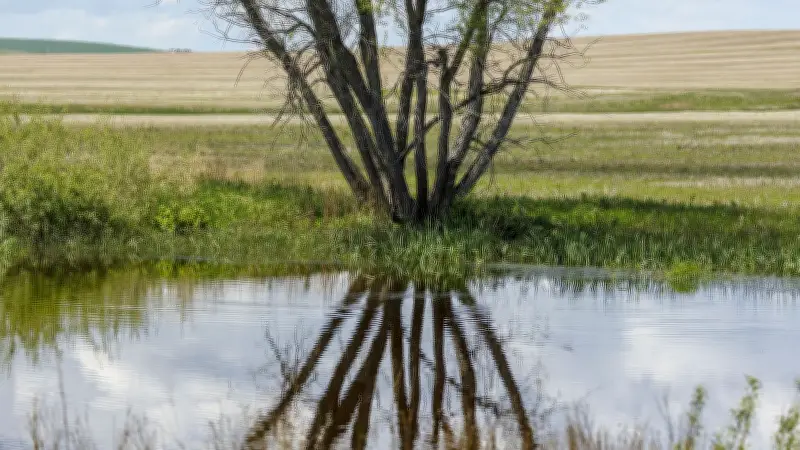
That was what I was seeking: roadside ponds and potholes and the life around them. For much of the year, they are barely damp, but with recent rain, I figured they might be fuller.

Dry Spots and Singing Frogs
Interestingly, several of my known spots were still fairly dry. Water was present, but vegetation had encroached around the edges over the last couple of dry summers, so I couldn't see much of the life around them. I could hear it, though. Frogs were singing at every damp spot, taking advantage of the moisture for late-spring courting. Tiny and mostly hidden, I never saw any of them.
Things changed once I reached the Rosebud River valley. More rain here, or perhaps a higher abundance of low spots, but either way, there were more potholes to explore, including some man-made ones.
Life at a Dugout
A dugout near Redland was overflowing with water, and life was taking advantage of it. Aspens, poplars, and a willow with rough-barked trunks stood along the banks, while frogs sang from drowned grass below. Shoveler ducks, teal, and mallards paddled around, and little red-necked phalaropes chased bugs across the surface.
It was damp and green near Redland, with particularly soft roads. The valley is flat-bottomed, with Serviceberry Creek adding its latte colour to the Earl Grey tint of the Rosebud just west of town.
Out in the open, kingbirds chased bugs, while in sheltered parts of south-facing slopes, little warblers and songbirds belted out choruses. A patch of aspens and poplars had a spring running through it fast enough to hear trickling, with horsetails in the shade near the stream. In brighter areas, osier dogwood bloomed, and wolf willow blossoms perfumed the air. A few chokecherries still had white flower stalks, and a feral honeysuckle bush in a hawthorn stand was crowned with pink petals.
Searching for More Sloughs
I swung west from Redland along the Wintering Hills toward Rockyford, hoping to find more sloughs, but had little luck. Either the rain hadn't hit as hard, or the ground was so dry it absorbed everything. Pastures were lush and green, and crops looked healthy, but I wanted birds and water, so I headed to a sure thing.
Severn Dam sits on a coulee between the Chimney Hills and the Wintering Hills. Its levels fluctuate, but with rain, I figured it would be full. It was, but the campground is now closed, so I could only reach the dam itself. I saw pelicans at the far end and cormorants flying around, but without a long hike, I was stuck. Gulls flew by, swallows swooped, and yellow-headed blackbirds hunted bugs among the rocks.
Green Pastures and Refilled Sloughs
The pastures were startlingly green between the hills, and cattle grazed contentedly. But the first set of potholes I passed were dry. I wondered if I'd chosen the wrong direction. However, a series of low spots where the Wintering Hills rise again all held water.
One slough, often dry and sulphurous, now held plenty of water. Reeds grew, bugs were everywhere, and I got my first mosquito bite of the year. Frogs buzzed loudly. Ruddy ducks splashed around, males with bright blue bills performing bubble dances. Yellow-headed blackbirds hollered from reeds, and eared grebes with bright red eyes swam about. I saw several of their nests.
More potholes on field edges held ring-billed gulls, willets, and gadwalls, but many had no birds. West of Rockyford along Serviceberry Creek, damp spots showed high water had flattened grass before receding. Cutoff meanders were full, but birds hadn't discovered them yet.
I found a Swainson's hawk with feathers and fresh blood on its claws, perched by an old farmhouse. Nearby, pheasants stayed close to caraganas, wary of the hawk.

Irrigation Country and a Final Surprise
I hoped to find more birds closer to irrigation country, but potholes north of Nightingale were mostly dry. I found a pied-billed grebe at a deeper slough surrounded by cattle, and a meadowlark posed for me. Time to head back toward Strathmore for food.
But Strathmore had more than food—it had what I'd been seeking all day. A slough next to a feedlot north of town had been filled by rain, and it teemed with birds: mallards, teal, coots, geese, gulls, black terns, grackles, rusty blackbirds, and dozens of eared grebes. They swam, dived, and nested. In a few weeks, striped baby grebes will appear.
I rolled into Strathmore, happy, but had to stop again at a pond in Gray Park. It had pelicans, herons, and cormorants. An itchy heron shared an island with cormorants, scratching as ducks swam by. I wished I'd ended there first, but that would have been too easy. Sometimes soft gravel roads and prairie potholes are just what I need.