Saskatoon's 1977 Sky Traffic Watch: Helicopter Pilot Bill Abbott's Aerial Reports
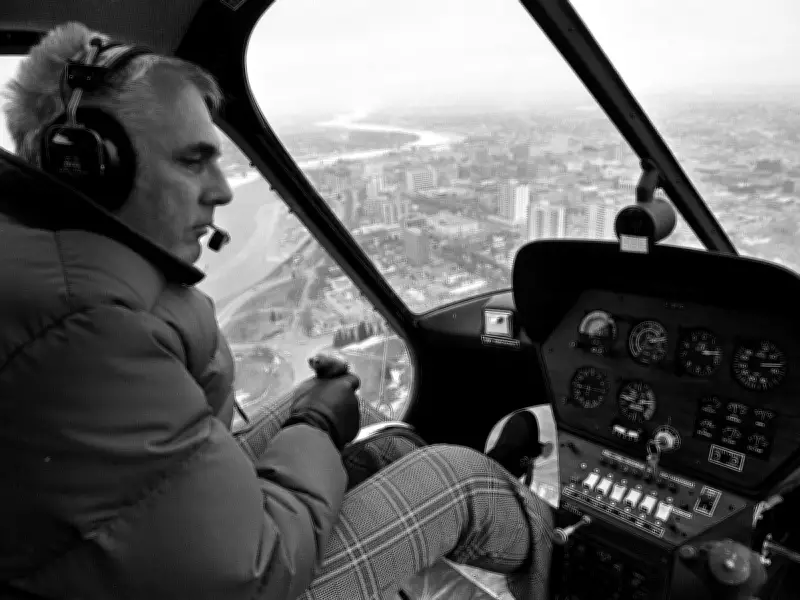
On this day in 1977, helicopter pilot Bill Abbott was keeping the city informed on traffic trends from the sky for CKOM radio. Every Thursday, we feature an image from the StarPhoenix archives, curated by the City of Saskatoon Archives. Today, we see helicopter pilot Bill Abbott flying over Saskatoon's roads for his reports and predictions on CKOM's Traffic Watch, from March 19, 1977.
The Man in the Helicopter
The next time you're stuck halfway across the University Bridge, take a few moments from contemplating the license plate in front of you to think about the man in that helicopter 1,000 feet above your head. If you had listened to him, chances are you wouldn't be in this mess. You would know about that stalled car at the top of the bridge... you would also know about the broken-down semi-trailer at Idylwyld and 20th Street... and the 49-unit freight inching its way across the Diamond.
The man is Bill Abbott of Pultz Aviation Training and he is flying CKOM's Traffic Watch. Weekdays from 4:29 to 5:29 p.m., radio listeners could get live reports and predictions on changing traffic patterns during the "rush hour." It's what CKOM programming manager Wally Cameron calls focusing on local services. And as a station promotion, he says reaction from the public indicates "the service is good."

"This is doing something for people," Cameron said.
Distilling Traffic Observations
For Abbott, his hour in the air adds up to attempting to distill his observation of five or six key traffic areas into six reports of about half a minute each. After clearing the ground at about 4:15 and advising the airport tower that Helicopter FYO will be in the air for the next hour, Abbott starts mentally putting together his first report. Initially, the pilot looks for road repairs, construction and trains.
Trains form a big part of the traffic picture in Saskatoon—there are so many places where they cross the roads. Abbott has acquired an uncanny knack of seeing a train at a distance and predicting when it will hit any given level crossing.
"It's not too hard to predict the long freights," he says. "The yard freights are difficult to predict."
He can estimate the length of a train using a rule-of-thumb formula gained over his 25 years in the air force. He views the train parallel to a strip of runway.
"If I can land an F-86 on it, then it's 5,000 feet long."
It isn't uncommon to find a 7,000-foot freight puffing its way across Idylwyld at 5:30 p.m. Abbott is at home in just about any type of aircraft, and was a military instructor in both jets and helicopters during various tours of duty across Canada and in Europe.
A Unique Public Service
This innovative traffic reporting service represented a significant advancement in local broadcasting and public information dissemination. By providing real-time aerial observations, CKOM radio offered Saskatoon residents a valuable tool for navigating the city's increasingly congested roadways during peak hours.
The combination of Abbott's military aviation experience and his keen observational skills created a unique public service that anticipated modern traffic reporting methods. His ability to predict train movements and identify potential bottlenecks from the air demonstrated how aerial perspectives could enhance urban mobility long before satellite imagery and drone technology became commonplace.
This archival glimpse into 1977 Saskatoon reveals how creative solutions to everyday problems were being implemented decades ago, blending aviation expertise with radio broadcasting to serve the community in practical, innovative ways.