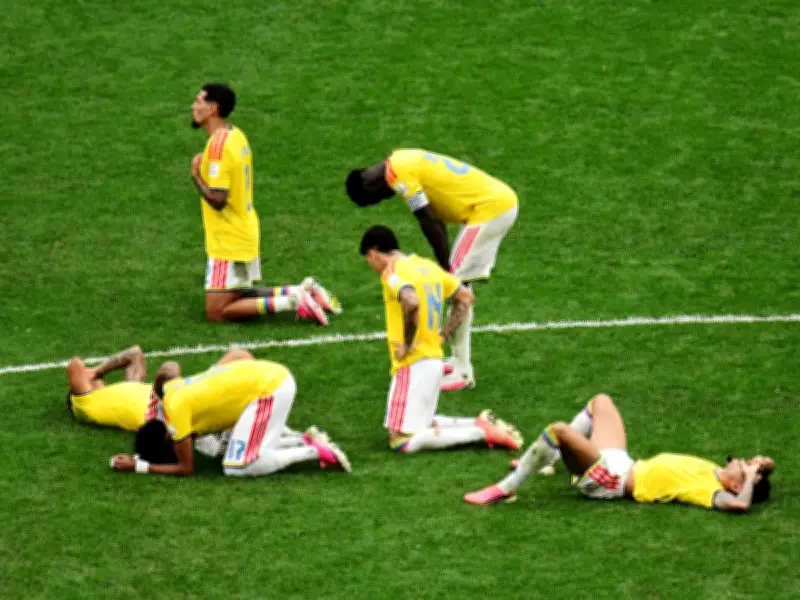
Colombia's World Cup campaign came to a heartbreaking end on Tuesday night as they fell to Switzerland in a penalty shootout after a goalless 120 minutes in the round of 16 at BC Place in Vancouver. The 3-0 shootout defeat left players sprawled on the turf in despair, while media waited in vain for post-match interviews as shouts in Spanish echoed from behind barriers but no players emerged for a significant period.
Head coach's brief appearance and candid assessment
Head coach Néstor Lorenzo eventually appeared for a truncated press conference, taking only three questions before departing with a terse “good evening, good afternoon, whatever.” When asked what was missing from his team's performance, Lorenzo replied simply: “A goal.” Through a translator, he elaborated: “We should have scored a goal. It's of my interest that the team makes attempts, at least, but you pay for those mistakes. You pay when you don't.”
Lorenzo defended his players, noting their quality: “In the last (World Cup qualifying) elimination round against Bolivia, Venezuela, we shot nine goals. These guys play at the major leagues, they're amazing players. There's nothing to reproach. The fact is that sometimes you score, sometimes you don't.”

Dominant statistics but no finishing touch
The statistics painted a one-sided picture in favor of Colombia. They registered 15 shots to Switzerland's 3, with an expected goals (xG) of 1.09 against Switzerland's 0.39. Darwin Quintero sent a free header from six yards over the bar in extra time, and the team also struck the post and the crossbar during the match. Despite their dominance, they could not find the net, and Switzerland's goalkeeper Gregor Kobel made crucial saves to keep his team in the game.
The Colombians traveled 12,225 kilometers during the tournament, the most of any team, but midfielder Jhon Arias refused to use that as an excuse. He was the only player to speak in the mixed zone, stepping up to the microphone to address the media.
Jhon Arias calls for internal change
“It's something that leaves us feeling very, very bitter,” Arias said through a translation. “But I also hope it can be the beginning of an internal change. Because I believe we had everything we needed to go further, but something was missing. We're not going to make excuses, we're not going to blame the pitch or the hotels or anything like that. I think the only thing left is to openly tell people that we take our share of the blame.”
Arias emphasized the need for reflection and growth: “I think the nation had great hopes, the whole country. … Whatever comes next, I hope this serves as a lesson. I think we're leaving with the feeling of not having been able to reach the goal we had set. And that leaves us with a bit of frustration, even though we did some good things. But change is necessary.”
He also struck a note of cautious optimism: “When your head is hot, when things like what happened today happen, the tendency is to be fatalistic, to believe that everything is bad. Personally, I don't think everything is bad. I think the World Cup gave us a good base, a solid foundation. We also have a solid core that we can build on. We have great players, players who know how to compete. I think we're on the right path. Clearly something is missing, obviously something is missing, and that is what we have to figure out, what we have to look for inside ourselves.”
Colombia's World Cup history and future outlook
Colombia has qualified for the World Cup six times, with three appearances in the last four tournaments. They have reached the round of 16 three times, with their best performance being a quarterfinal appearance in 2014. This early exit adds to a pattern of falling short at the knockout stage, and the team now faces introspection as they look ahead to future competitions.