John Graves Simcoe's Ambitious Vision for Upper Canada
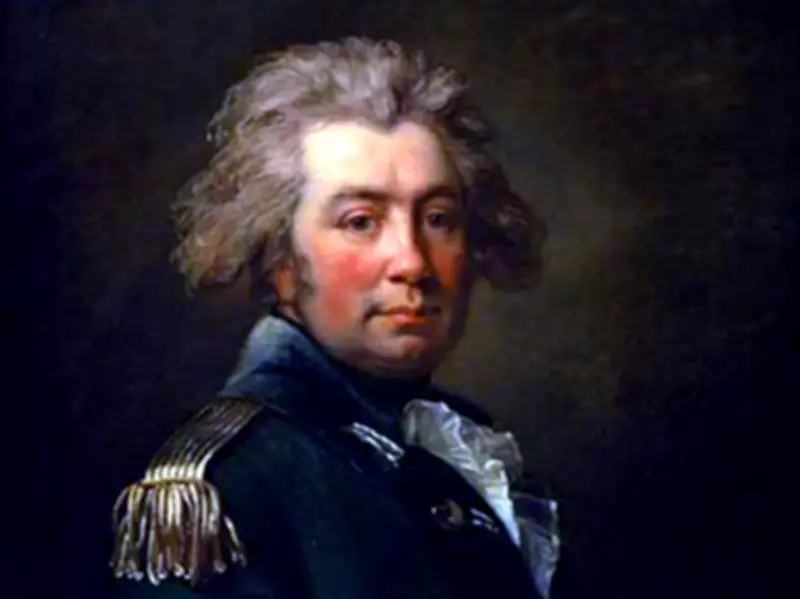
John Graves Simcoe harbored a grand ambition: to transform Upper Canada, the territory that would later become Ontario, into a thriving and steadfastly loyal British province. His vision extended beyond mere prosperity; he sought to establish a society that would stand as a moral and political counterpoint to the newly independent United States.
A Blueprint for a Superior Province
Simcoe's plan for Upper Canada was comprehensive and deeply ideological. He envisioned a province built on English legal traditions and robust commerce, supported by an efficient road network and strategic military settlements inspired by the Roman Empire. Central to his vision was the creation of an aristocratic, Anglican-influenced society that would explicitly reject the institution of slavery, which he viewed as a profound crime.
He believed this model would result in "a superior, more happy, and more polished form of government" compared to the United States. Remarkably, Simcoe's ambitions did not stop at creating a rival province. He ultimately hoped to undo the American Revolution, believing that a silent majority in the former colonies opposed the rebellion, and thus sought to reabsorb the United States under the British Crown, thereby reuniting the Empire.

Humble and Audacious Beginnings
The origins of this grand project were surprisingly modest. Ontario began as a separatist frontier enclave with a population of only about 6,000, primarily composed of former American arrivals to the "Upper Country." With considerable audacity, these early settlers demanded the creation of their own province, carved out of the much larger Province of Quebec, which had a population of 130,000.
They insisted on equal provincial status and representative government. To shape this nascent province, Simcoe introduced military settlements constructed by militia and populated by veterans, with plans for westward expansion. He operated under the conviction that the American Republic would eventually collapse and return to British America.
Contemporary Perceptions and Historical Context
Some contemporaries and later historians questioned the practicality of Simcoe's vision. One historian described him as "an intellectual magpie, an impractical dreamer." His fervent opposition to the United States was noted as extreme; a visiting French aristocrat, Count Rochefoucauld, observed Simcoe's "inveterate hatred of the United States, which he too loudly professes and which he carries too far." Simcoe himself declared he would be prepared to endure extreme suffering to bring back "wavering provinces" like Maine and Rhode Island.
The Complex Reality of Slavery on the Frontier
Simcoe held a particular disdain for slavery and advocated for its complete abolition. However, the situation on the Upper Canadian frontier was intricate and multifaceted. For instance, Six Nations Chief Joseph Brant did not comprehend the objections British officers had regarding his ownership of forty Black individuals, whom he believed were "happy, and entirely willing to live with him."
Rochefoucauld also documented instances of Indigenous trappers who owned Black slaves to carry their equipment and game. This practice was not uncommon, as the absorption and utilization of captives were normalized within many Indigenous societies. Historian Brett Rushforth notes that the exchange of captives with white settlers became "powerful symbols of their emerging partnership."
The first efforts to mitigate the conditions of slavery in the region were undertaken by Jesuit missionaries in the 1630s, such as Father Paul Lejeune, who attempted to ransom slaves. This historical context is complex for modern readers, as domestic slavery was also an established practice in New France, reflecting the broader norms of the era.
Simcoe's legacy, therefore, is a tapestry of lofty ideals, ambitious geopolitical strategies, and the stark realities of early Canadian society, marking a pivotal chapter in the nation's development.