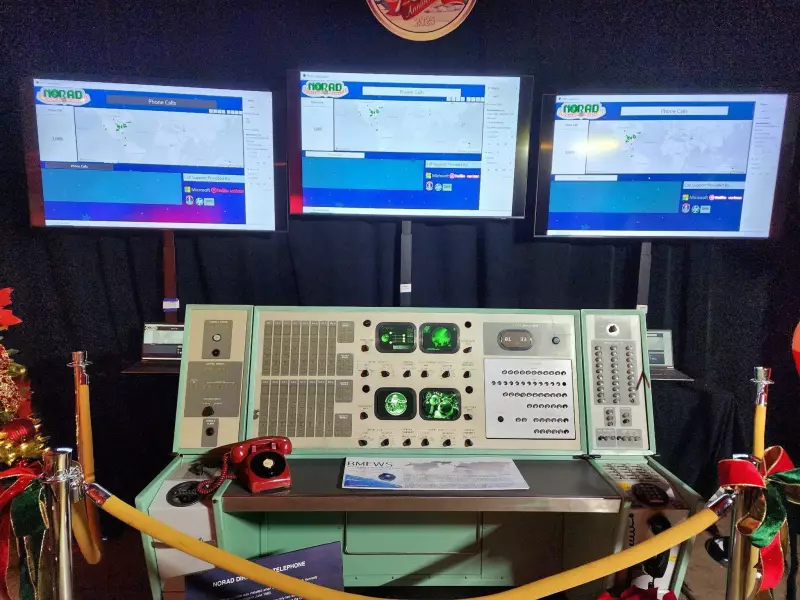
As Christmas Eve arrives, children across Canada and around the globe are once again glued to screens, not for video games, but to monitor the magical journey of Santa Claus. The source of this real-time intelligence? The North American Aerospace Defence Command (NORAD), which has transformed its high-tech military surveillance into a beloved holiday tradition for the seventh consecutive decade.
The Festive Mission of a Military Command
While NORAD's primary duty is the solemn task of protecting North American airspace, each December 24th its resources are joyfully diverted. Using advanced satellite technology, the command tracks Santa's sleigh with military-level precision, plotting its course on a live-updating map available to the public. This data is shared not only on the official NORAD Tracks Santa website but also across its social media channels on X, Instagram, Facebook, and YouTube.
The operation is a well-oiled machine. Beginning in the early morning hours of December 24th, uniformed personnel and a dedicated team of civilian volunteers man the NORAD Tracks Santa Operations Center. They stand ready to answer a flood of phone calls at 1-877-HI-NORAD and provide eager children with the latest updates on Santa's location as he departs from the North Pole.

A Heartwarming History: The Accidental Tradition
This unique partnership between a military institution and a festive icon began not by design, but by a charming mistake. The story dates back to 1955, when a Colorado Springs newspaper advertisement invited children to call Santa Claus. The ad accidentally printed the phone number for the Continental Air Defense Command (CONAD) Operations Center instead.
Rather than hanging up, the officer on duty that night, Colonel Harry Shoup, played along and gave the children updates on Santa's supposed location. The goodwill gesture was so popular that it became an annual duty for CONAD and, after its formation in 1958, its successor, NORAD. What started as a simple error has now blossomed into a global phenomenon that delights millions each year.
Mapping the Magical Route
According to NORAD's historical data, Santa's journey typically follows a westward path. He often begins by tracking the International Date Line in the Pacific Ocean, making his initial deliveries in the South Pacific, New Zealand, and Australia. From there, his route winds through Asia, Africa, and Europe before he finally crosses the Atlantic Ocean to visit homes across Canada, the United States, Mexico, and Central and South America.
While NORAD experts can provide a general live map, they emphasize that Santa's exact schedule remains a closely guarded secret. "Only Santa knows his route, which means we cannot predict where and when he will arrive at your house," the agency states on its website. However, they offer a crucial clue from years of observation: the jolly old elf seems to arrive only when children are sound asleep.
For parents, this tracking service is more than just fun; it's a valuable negotiation tool to encourage timely bedtimes on Christmas Eve. Whether you're a child counting down the minutes, a parent in need of a convincing argument, or simply a fan of holiday magic, the NORAD Santa tracker is officially live, bringing a touch of military precision to the most wonderful night of the year.