In the wake of the tragic attack at Sydney's Bondi Beach during Hanukkah celebrations, a profound reflection on darkness, light, and communal solidarity emerges, particularly resonant for a Canadian audience. Father Raymond J. de Souza, writing for the National Post, draws parallels between seasonal observances and current events, finding a persistent flame of hope.
The Seasonal Paradox of Light and Darkness
Judaism and Christianity, both Mediterranean faiths, mark their festivals of light—Hanukkah and Christmas—during the northern hemisphere's darkest days. This year, however, the symbolic darkness became tragically real in Sydney on December 19, 2025, where a summer Hanukkah gathering at Bondi Beach was shattered by violence. The attack, perpetrated by a father and his son, imposed a profound shadow on a time meant for illumination.
De Souza notes the poignant contrast: while these lights traditionally pierce winter's gloom, in the Southern Hemisphere, they are kindled amid summer's longest days. Yet, as the event proved, human cruelty can summon darkness regardless of the season or the sun's brilliance.

Shared Rituals and the "Tiny Flame"
The Catholic tradition of the Advent wreath, with its four candles lit successively, mirrors the incremental lighting of the Hanukkah menorah. This year, composing new prayers for the Advent wreath, de Souza recalled the words of St. John Paul II from World Youth Day in Toronto in 2002.
"Even a tiny flame lifts the heavy lid of night," the late Pope declared. This image, de Souza argues, is powerfully fitting for the current moment. John Paul II, having lived under oppressive regimes, expressed an "unshakable conviction" that hope, especially in the young, cannot be fully extinguished—a conviction now tested by events like the Bondi attack.
The scripture read at Christmas Mass from St. John's Gospel—"The light shines in the darkness, and the darkness has not overcome it"—serves as a central tenet. The darkness, as seen in Sydney, strives relentlessly, but the light persists.
A Call to Action and Shared Burden
De Souza extends the reflection into a call for solidarity and moral action. He references the prophet Isaiah, cited by John Paul II in Toronto, urging to "loose the bonds of injustice" and "share your bread with the hungry." The act of extending a hand, he suggests, is itself a light.
For the Jewish community, bearing a heavy burden of grief and trauma, the support of gentiles—those outside the faith—can be a crucial "tiny flame of light." De Souza highlights the unique vocation of the Jewish people, quoting Isaiah 49:6, which speaks of being "a light to the nations."
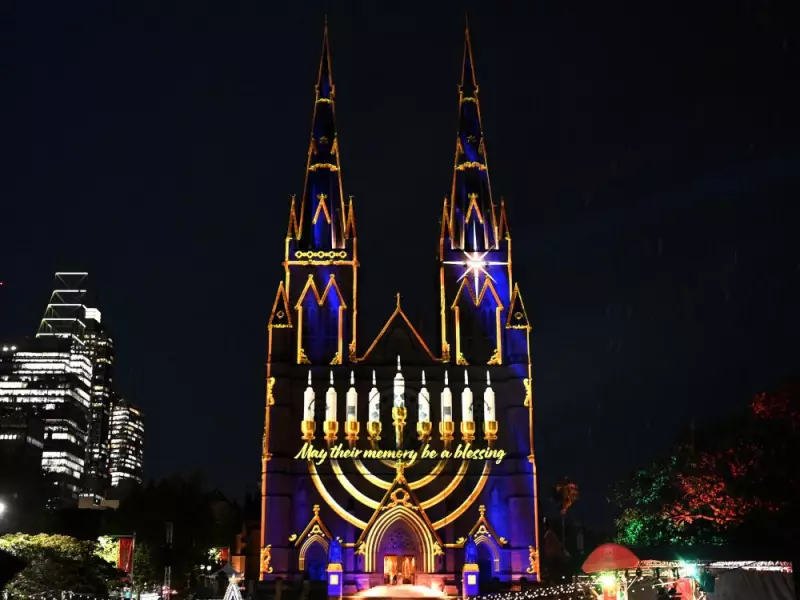
In conclusion, the article posits that the witness of a single soul or a people can shine defiantly in the darkness. The illuminated menorah projected onto Sydney's St. Mary's Cathedral in tribute to the victims stands as a powerful symbol of this shared light and the enduring hope that, though challenged, is never fully overcome.