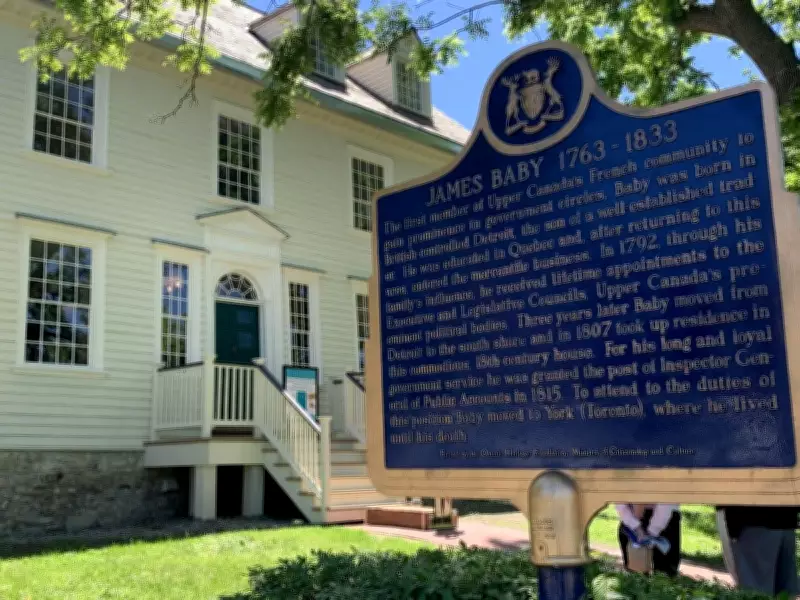
After two years of extensive restoration, one of Windsor's most significant historic landmarks, the Duff-Baby House in Sandwich Town, reopened to the public on Saturday, May 30, 2026. The reopening featured free tours, newly installed exhibits, and an easy-to-use interpretive app that enhances the visitor experience.
Three Period Rooms Showcase History
The house now features three rooms that depict different periods in its long history. The trading hall reflects the era around 1798, when Alexander Duff, the first owner of the house, resided there. The dining room is set to illustrate September 1813, just before the Battle of the Thames. The third room portrays 1939, when Dr. William Beasley, Sandwich town's physician, and his wife lived in the home.
Each room is furnished and decorated according to its respective period, complete with mannequins dressed in historically accurate attire. These mannequins represent former owners as well as notable historical figures who visited the house, including Shawnee leader Tecumseh and British General Henry Proctor.

Innovative Interpretive App
Don Wilson, president of Les Amis Duff-Baby, the volunteer group promoting the historic house, explained that the restoration includes both QR codes and a dedicated app. "We have developed as part of this both a QR code and an app that shows what the different rooms offer. This is unique in Windsor at this point," Wilson said.
Visitors can scan QR codes placed throughout the three-storey building to access the app, which provides in-depth details about the objects and exhibits. Volunteer Savannah Lesperance noted, "It's basically a virtual tour and there's a QR code on different objects. You can scan it and it gets a description of it and explains everything." The app also includes special sections tailored for children.
Volunteers and Rare Artifacts
During tours, volunteers are on hand to share the home's rich history and details about the recent rehabilitation work. One of the museum's rare items is a circular sock machine, manufactured in 1914 and issued by the government during the First World War to assist women in knitting woolen socks for soldiers. Volunteer Kate Rosser-Davies explained that most of these machines were melted down during the Second World War for scrap metal to produce weapons. The fully restored, working machine is displayed in the home's 1939-era sitting room.
Matt Gillard, a student teacher from London hoping to teach visual arts and history, visited the museum for the first time to learn more about the War of 1812. "I love all the costumes that have been put up and the artifacts that they've done and the attempts they've made to restore the house and present it as it would have looked like in the early 1800s," Gillard said.