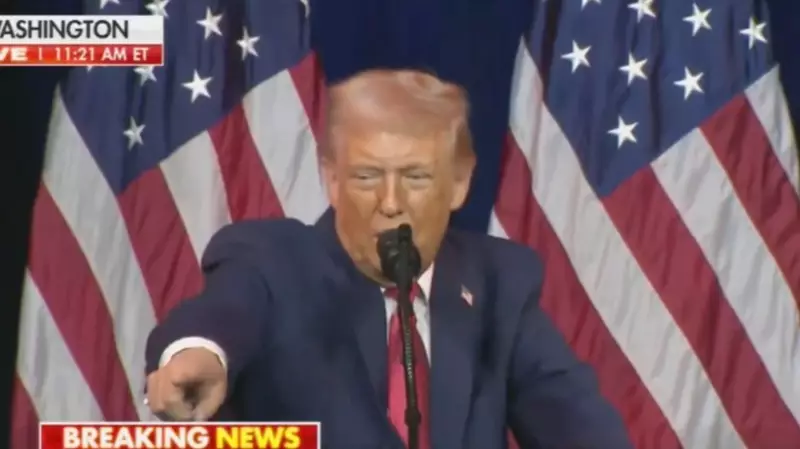
In a moment that blended political spectacle with personal grievance, former U.S. President Donald Trump halted a public address this week to directly confront a photographer he accused of making him appear overweight in pictures.
A Speech Interrupted by a Personal Request
The incident occurred on Tuesday during Trump's remarks at the Kennedy Center in Washington, D.C. After a customary jab at the "fake news," the former president's attention was drawn to New York Times photographer Doug Mills, who was positioned in the crowd.
Trump immediately recognized Mills, who won a Pulitzer Prize in 2025 for his iconic photograph capturing the moment a bullet grazed Trump during an apparent assassination attempt in Butler, Pennsylvania, the previous year. "Pulitzer Prize! Pulitzer Prize!" Trump exclaimed, gesturing toward Mills. "Right, Doug? He got one for the bullet. He had the bullet. But he got – how many Pulitzer Prizes? Three Pulitzer Prizes."

From Praise to a Public Critique
Trump briefly complimented the photographers positioned directly in front of him, calling them "all talented guys" and "great guys." However, he quickly clarified his stance wasn't universal, gesturing to the back of the room and stating, "I don't like the people back there," while sucking his teeth as the audience laughed.
His focus then returned squarely to Doug Mills. In a public plea that shifted the tone of the event, Trump suddenly begged the acclaimed photographer to change his approach. "Make me look thin for a change, Doug," he jested. "You are making me look a little heavy. I'm not happy about it."
A Pattern of Public Commentary on Appearance
This is not an isolated incident for Trump, who has a long history of commenting publicly on physical appearance, both his own and that of others. For instance, in October 2025, he compared his "beach body" to that of current President Joe Biden, quipping, "I'm not sure it would be appreciated on the beach, but I'm not gonna take a chance."
The exchange at the Kennedy Center underscores how Trump continues to command media attention and directly engage with the press, even on seemingly trivial personal matters, often blurring the lines between political discourse and personal banter.