The month of June provides many opportunities for reflection. You may find yourself sitting in a humid auditorium waiting for graduates to get their tassels moved from right to left. Perhaps, you'll be waiting for the arrival of a bridal party who have detoured into a local park for interminable wedding photos. Maybe you'll be stuck at a departure gate waiting on a delayed inbound plane. Vast swaths of June move slowly. Make it a point to have something to read. If nothing else, use the time to ponder the mysteries of the universe.
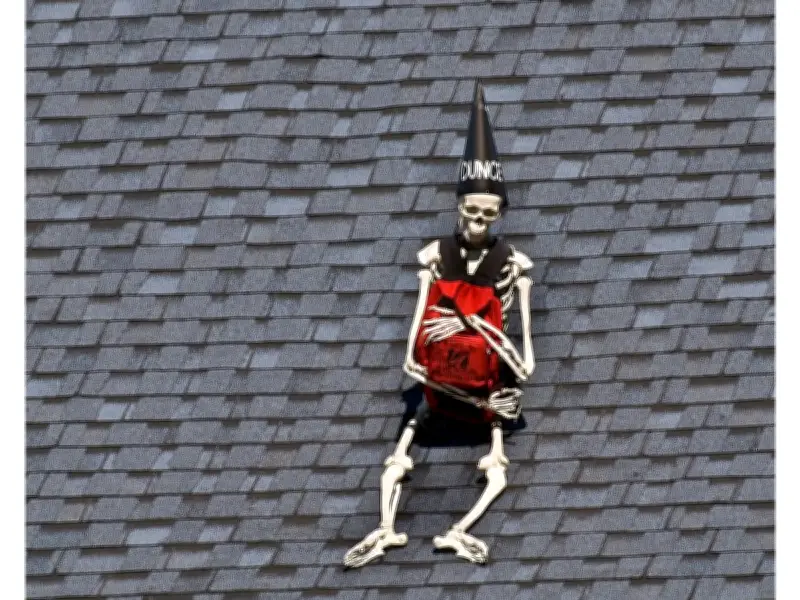
I recently attended a graduation ceremony and got to wondering about those odd, square-shaped hats grads wear. They are commonly called mortar boards, which is puzzling, as bricklayers use mortar boards for holding the stuff that sticks one brick to another. Is there some symbolism there, I wondered? A mortar board on your head has long been an indicator of intelligence. The opposite of a mortar board is a dunce's cap — a big, white cone. One hat is flat, one hat is pointed. One hat says "smart", the other hat says "stupid". These two toppers are at opposite ends of the hat taxonomy. Where did this all come from?
As with most things, it turns out that the history of both hats is complex and surprising.

The Origins of the Mortar Board
It turns out the graduation cap has an ancient history dating back to the 1500s when Catholic clerics and scholars in Italy wore something referred to as a biretta, which itself is thought to have evolved from the pileus quadratus. As you're not a cone-hat wearing person but a person who reads newspapers, it won't be lost on you that quadratus means square.
The pileus quadratus was a type of skullcap with a small mound at the top. Learned people wore these hats. Once identified with academia, the association stuck and gradually spread to Britain and on to North America. The standard became that students wore these square, flat hats along with a robe related to the student's field of study. There was a time when both were worn daily.
Depending on the institution, there are intricate rules about all of this academic regalia. Lore has it that students at Oxford University bring their caps with them to all exams, but can't wear the caps until graduation. At Oxford, students are required to dress sub fusc — which is to say, in a dark suit or skirt with a plain, white shirt or blouse under their robes when attending ceremonies or when writing exams. Clearly, I didn't attend Oxford as I wore a hot pink jersey dress under my gown when I graduated from UBC. At any institution, robes and coloured tassels indicate the field of study. A gold tassel is reserved for achieving doctoral status or academic honours.
The Surprising History of the Dunce Cap
The history of the dunce cap is not what I would have expected. The head gear that became a symbol of public humiliation started out as anything but. Whereas teachers used to use this hat as a form of discipline, the hat started out as an identifier of followers of a highly respected Scottish theologian and philosopher named John Duns Scotus. Yes, that's where the name dunce comes from — Duns. His followers were known as Dunsmen, or Dunces. Dunsmen wore a tall, conical hat that was theorized to function as a metaphysical funnel for wisdom and knowledge. In time, Duns' teaching fell out of favour and the term — and the hat — became associated with backwardness. Nonetheless, John Duns Scotus was beatified by Pope John Paul II in 1993.