The Demolition of Bill Reid's Monumental Habitat Forum Mural
Bill Reid stands as one of British Columbia's most celebrated and influential artists, whose work has left an indelible mark on Canadian cultural heritage. However, on February 21, 1977, a significant piece of his artistic legacy faced destruction when the Vancouver park board initiated the demolition of one of his most striking and large-scale works.
A Mural for Habitat Forum
In preparation for the Habitat Forum, a conference of non-governmental organizations that ran from May 27 to June 11, 1976, Reid collaborated with several assistants to create a monumental mural on the side of an old aircraft hangar at Jericho Beach. The Habitat Forum served as a public-focused offshoot of the United Nations Conference on Human Settlements, which was held concurrently in downtown Vancouver and attracted politicians from over 140 nations.
The mural adorned what was known as Hangar 3, one of several structures left from Jericho's time as a Royal Canadian Air Force seaplane base from 1920 to 1947. As visitors entered the Habitat Forum, they were greeted by Reid's vibrant and imposing artwork, which transformed the utilitarian hangar into a canvas of cultural expression.

Artistic Significance and Design
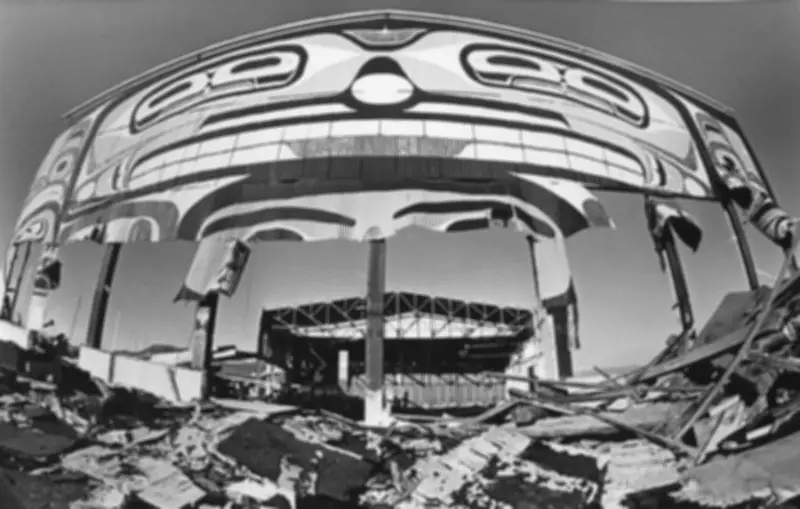
Reid's mural was executed in a distinctive First Nations motif, drawing inspiration from traditional Haida art forms. The design featured a stunning blend of blue, red, black, and white colors, creating a visually arresting piece that evoked the imagery of a First Nations longhouse front.
According to Aliya Boubard, curator at the Bill Reid Museum, the mural appeared to mimic traditional housefront designs that would have been painted on longhouses to depict family crests. Boubard noted, "It's unclear what the main figure in the center top appears to be, but the figure in the center underneath looks to be a human. On either side, there is a wolf and underneath the wolf is a salmon-egg design."
To create this massive work, Reid projected one of his existing designs onto the south side of the hangar. Artists then used lifts to paint the mural over the corrugated metal panels that clad the structure. While the exact dimensions remain undocumented, estimates suggest the mural was approximately four to five storeys high and over 30 metres wide, making it a truly monumental public art installation.
The Controversial Demolition
Despite the Habitat Forum's popularity during its brief 2½-week run—with attendees fondly remembering features like the world's longest bar that stretched through one hangar—the Vancouver park board began discussing the demolition of the hangars shortly after the event concluded.
The park board had only gained full control of Jericho Beach in 1973-74 following a transfer from the federal government to the city. According to Terri Clark, former head of public relations for the park board, superintendent Stuart Lefeaux had been "hoping against hope that they'd be able to take down some of the hangars and make a proper park, as he would call it." This suggests the board may not have been entirely supportive of the Habitat Forum's temporary use of the structures.
The demolition that began on February 21, 1977, marked the end of this significant cultural artifact, removing from Vancouver's landscape a work that bridged contemporary public art with traditional First Nations artistic traditions. The loss of Reid's mural represents not just the destruction of a physical artwork, but the erasure of a meaningful cultural moment in the city's history.