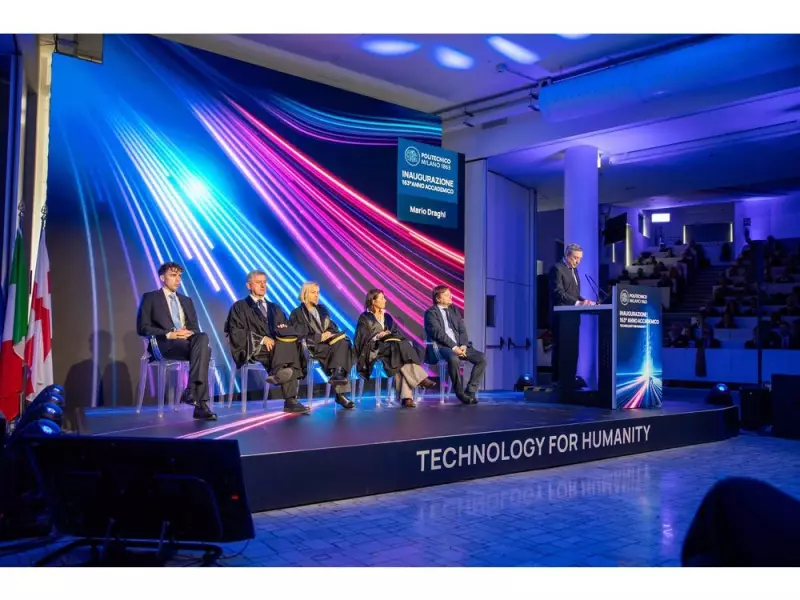
The Politecnico di Milano officially commenced its 163rd academic year on December 1, 2025, with a ceremony that placed a strong emphasis on responsibility, knowledge, and cohesion. The event unfolded against a backdrop of global polarization and profound change, with university leadership outlining a forward-looking vision centered on scientific diplomacy and European identity.
A Call for Critical Thinking and Responsibility
In her inaugural address, Rector Donatella Sciuto positioned the institution as a crucial intermediary in a complex world. She argued that the Politecnico's role is to piece together a broader perspective, transforming societal and technological change into meaningful progress through measured reflection and critical analysis.
Rector Sciuto issued a stark warning about the fragility of civilization in the absence of accountability. She identified polarization, disinformation, and geopolitical tensions as significant threats to mutual trust. "Today, more than ever, we need free spaces in which to exercise our autonomy, far from autocratic ideologies," she stated, reaffirming the university's commitment to being a bastion of dialogue and civic responsibility.

Scientific Diplomacy as a Strategic Pillar
A core theme of the inauguration was the university's expanded role in scientific diplomacy. This concept is set to be a central lever in the forthcoming Strategic Plan for 2026-2028. Professor Sciuto highlighted the Politecnico's active track record, having promoted over 60 international research and cooperation initiatives between 2023 and 2025.
The institution has significantly deepened ties with African nations, seeing a 25% increase in collaborative projects. It has also launched eight partnerships with United Nations agencies. Furthermore, its two UNESCO Chairs, first established in 2012, have been confirmed for a fourth renewal. "The Politecnico di Milano stands at the centre of a new scientific diplomacy, contributing our expertise to peace and international collaboration," Sciuto declared.
Strengthening Europe's Innovative Future
The vision for a stronger, more unified Europe was another cornerstone of the ceremony. The Politecnico plans to establish a permanent office in Brussels in 2026 to enhance dialogue with European Union institutions. This move is strategically timed ahead of the launch of the next major EU research framework, FP10.
The university is also taking concrete action to address Europe's innovation gap, a challenge highlighted by President Mario Draghi in his recent Competitiveness Report. A key example is the Tech Europe Foundation (TEF), a joint venture with partners including Università Bocconi. TEF has already raised 120 million euros, financed more than 50 researchers, and launched programs to cultivate scientific entrepreneurship.
Rector Sciuto framed Europe not just as a political entity but as a shared cultural and scientific space. She cautioned that for Europe to compete in global technological transitions, it must first heal its internal divisions. "A Europe founded on Enlightenment notions and ideals today finds itself having to reflect on its own fractures," she observed, noting its current difficult position on the world stage.
The ceremony was attended by notable figures including Milan Mayor Giuseppe Sala, Lombardy Region's Councillor for University Alessandro Fermi, Student Council President Michele Gaetano Giussani, and President of the Politecnico di Milano, Mario Draghi. Among the practical innovations announced for the coming years is the launch of three new Bachelor of Science courses in engineering, which will be taught entirely in English.