An insurance provider for Quebec's school boards is facing significant backlash after issuing a detailed set of recommendations governing the construction and supervision of snowbanks in schoolyards. The guidelines, which specify precise height, slope, and inspection protocols, have been denounced by staff unions and politicians as an excessive bureaucratic response to a simple childhood winter pleasure.
Strict Specifications for Winter Fun
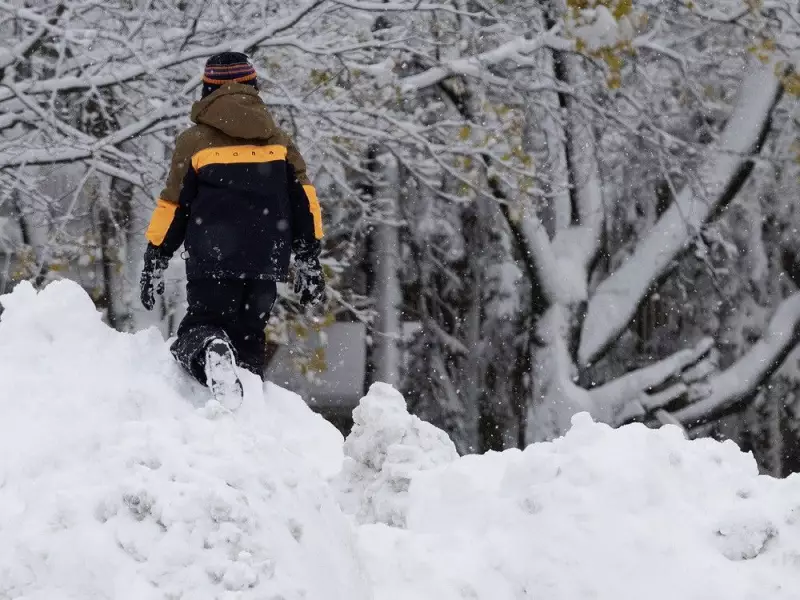
The Union réciproque d’assurance scolaire du Québec (URASQ), which insures most of the province's school boards and service centres, recently sent the recommendations to its 65 members. The document, obtained by the Montreal Gazette, stipulates that snow mounds for play should be between 1.8 and 3 metres high and have a slope not exceeding 25 per cent.
Furthermore, the guidelines call for clearly marked waiting and resting zones, daily inspections, and detailed record-keeping. Schools are advised to log the "state of the snow, imperfections, presence of water or ice" and maintain a calendar tracking which student groups use the mound, rotating by age and competence level. Should these measures prove impossible to follow, the insurance company suggests an alternative: having children wear helmets while playing on the snowbanks.

Unions and Politicians Cry Foul
The first and loudest criticism came from the union representing school support staff, who would likely bear the responsibility of implementing the complex rules. Éric Pronovost, president of the Fédération du personnel de soutien scolaire (FPSS-CSQ), called the guidelines absurd.
"We’re talking about snow mounds, not construction sites," Pronovost stated. "Turning a simple winter game enjoyed by children into a bureaucratic exercise is absurd: measuring tapes, registers, plans, increased supervision … all of this once again falls on school support staff."
The recommendations also drew fire from Quebec Premier François Legault. In a December 17, 2025 interview on Radio-Canada, Legault dismissed the idea of helmets in schoolyards as excessive. "It doesn’t make sense," he said. "I understand that it has to be safe, but to start to put helmets in the schoolyard, I find that a bit much."
This stance aligns with a 2024 directive from then-education minister Bernard Drainville, who advocated for a return to snowbanks in schoolyards, reminiscing about his own childhood games of "King of the Mountain."
Insurance Company Defends Safety Focus
URASQ's executive director, Caroline Vermette, explained that the recommendations were inspired by the ministerial directive and were intended to help schools establish safe play areas. In an email, she emphasized the goal was "exercising due diligence to ensure the activity is conducted safely, in the best interests of the children."
Vermette clarified that helmets are not a blanket requirement, but a risk-mitigation measure if the primary recommendations cannot be met. "URASQ’s recommendations do not impose a new burden on school staff. Provided these recommendations are followed, helmets are not required," she wrote.
However, Pronovost countered that the practical burden inevitably lands on already overworked support staff. He fears the rules will lead to more time managing equipment than supervising play, and predicted some schools will simply abandon snow mounds altogether, robbing children of winter fun.
A Possible Link to Past Litigation
A union spokesperson suggested the stringent rules may stem from a March 2022 Court of Quebec decision. In that case, the Commission scolaire des Grandes-Seigneuries was ordered to pay over $14,700 in damages after an 11-year-old girl slid into a fence on a school snowbank in February 2018, knocking out two teeth. The judge found the school board at fault for allowing a steep slope near a fence and providing inadequate supervision.
Notably, Richard Poirier, the president of URASQ's board of directors, was recently named interim assistant executive director of that same school board. While Vermette confirmed Poirier holds both positions, she stated URASQ was unaware of the specific lawsuit when crafting its recommendations.

The controversy highlights the tension between managing liability in an increasingly litigious environment and preserving unstructured, traditional play for children, setting the stage for further debate as winter settles across Quebec schoolyards.