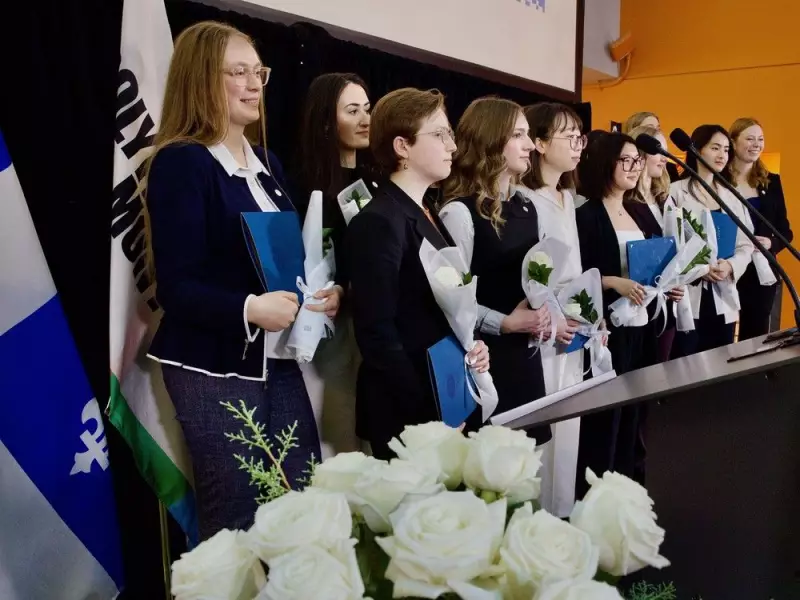
In a significant expansion of a poignant legacy, The Order of the White Rose scholarship will now be awarded to 14 young women, a move that has stirred deep emotions in Montreal's academic and memorial communities. The change, from a single recipient to one for each victim of the 1989 École Polytechnique tragedy, was announced in late 2025.
A Teacher's Sacred Duty of Remembrance
Vivianne M. Silver, a retired professor of French as a Second Language and Women’s Studies from John Abbott College, expressed profound joy at the news. For years, Silver held a sacred duty to ensure December 6 was properly observed.
In a designated campus location, 14 of her students—both male and female—would each light a candle in memory of the 14 young women murdered at the engineering school. The ceremony often included songs, poems, and shared journal entries. The remembrance held special weight, as one of the victims, Anne-Marie Edward, was a former John Abbott science student.

The Scholarship's Blossoming Impact
The Order of the White Rose was established as a scholarship and sisterhood to commemorate the victims. Its expansion means 14 new recipients will each receive financial support to pursue studies in a field of their choice, a direct and living tribute to the futures cut short.
"It is my fervent prayer that the 14 inductees will carry the torch of light and of hope into her future," Silver wrote from her home in Côte-St-Luc.
Broader Context: A Week of Public Discourse
The letter regarding the scholarship was part of a series of published public responses in The Montreal Gazette. Other letters addressed contentious provincial issues, reflecting a week of significant public feedback.
One letter from Elaine Sher of Dollard-des-Ormeaux expressed hope regarding pushback against Bill 1, the CAQ government's proposed Quebec constitution. The writer noted that 211 groups and individuals were set to appear at hearings, viewing the substantial public engagement as a sign of holding the government accountable.
In another, retired physician Morton Kapusta of Côte-St-Luc criticized the Quebec government's treatment of doctors in relation to Bill 2, comparing current policies to past conscription into the medicare system and arguing that such an approach harms productivity and the work environment.
The collective correspondence underscores a community actively engaging with both somber remembrance and contemporary political debate, linking past tragedies to present-day advocacy and policy.