Calgary Catholic School Blocks Student's Performance of Explicit Poem in National Competition
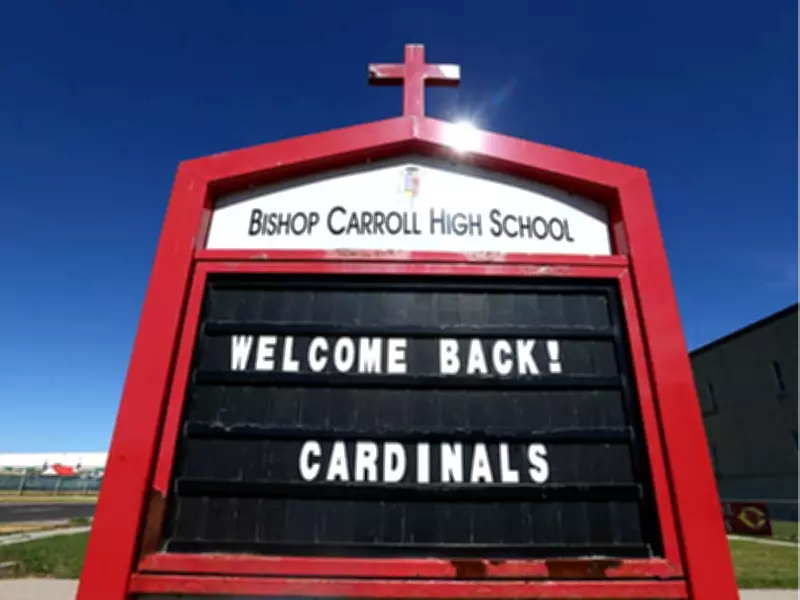
A 17-year-old student at Bishop Carroll High School in Calgary has been forbidden from performing a poem containing explicit language in the initial round of a national poetry competition, despite receiving support from her parents, teachers, and the poem's author. The decision by the Catholic school administration has ignited a heated discussion about censorship, freedom of speech, and the educational value of confronting difficult social issues through art.
Student Voices Frustration Over Censorship Decision
Josephine Trigg, a Grade 12 student at Bishop Carroll High School, expressed profound frustration with her school's decision to prohibit her from reciting the poem titled Dick Picks in the Poetry in Voice competition. "I'm feeling incredibly frustrated," Trigg stated, emphasizing that she believes the school's censorship has effectively stifled her freedom of speech and artistic expression. The national competition, which Trigg has participated in for the past two years, lists the poem as an acceptable work for students in grades 10 through 12 on its official website.
Poem Addresses Modern Phenomenon of Online Harassment
The controversial poem, written by author Sarah Tsiang, explores the disturbing reality of unsolicited explicit images that women frequently receive in their digital inboxes. Written from the perspective of a mother discovering her daughter has been harassed online, the poem uses vivid and explicit language to describe male genitalia, comparing it to an "overcooked hotdog," an "aborted fetus," and a "close up of a thumb." Through these striking metaphors, Tsiang critiques both the ubiquity of such images and the toxic masculinity that often accompanies their transmission.

"I felt this poem really brings attention to the issue, but in a way you can't ignore, especially because of the vocabulary used in it," Trigg explained, highlighting how the poem's provocative language forces readers to confront the uncomfortable reality of digital harassment.
Educational Support and Parental Approval
Trigg initially hesitated to select the poem due to its explicit content, but a seminar led by her English teacher, Tyler Perry, helped shift her perspective. "He told us that words are just words, so they're only what you make them out to be," Trigg recalled. "And I feel as if I matured a little bit more in my vocabulary because I've been reading lots of feminist literature."
To her surprise, when Trigg discussed the poem with her mother, Isabella Larose—a French teacher at Conseil scolaire FrancoSud in Calgary—she discovered her mother had already encountered the work and strongly supported her daughter's choice. "I wasn't sure I should propose it to her," Larose told Postmedia. "I was like, 'Oh my gosh, I'm so for it.'" Larose emphasized that the poem's theme transcends generations, despite focusing on a modern digital phenomenon. "This is a way of harassing girls," Larose noted. "Now we don't go around and lift their skirts. We just send them dick pics."
Author Criticizes School's Decision
Poet Sarah Tsiang expressed disappointment with the school's decision to ban the performance, arguing that the administration is making the critical error of divorcing meaning from language. Tsiang's poem deliberately contrasts the commodification of women's bodies in artistic contexts with how phallic symbols—found in "filthy bars and bathrooms," "wooded parks," and "shadowed alleys"—are weaponized to oppress women in digital spaces.
The controversy raises important questions about:
- The role of schools in mediating student expression
- The educational value of confronting social issues through provocative art
- The balance between protecting students and encouraging critical engagement with difficult topics
- How institutions respond to works that challenge traditional boundaries of acceptable language
As the debate continues, Trigg's experience highlights the ongoing tension between institutional policies and individual artistic expression in educational settings, particularly when addressing sensitive contemporary issues like online harassment and digital privacy.