Minnesota Schools Grapple with Immigration Enforcement Creating Climate of Fear
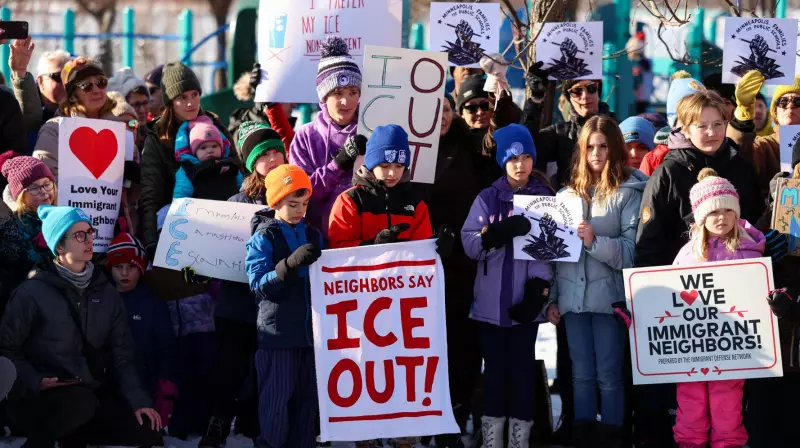
The Trump administration's immigration enforcement actions in Minnesota have created a pervasive atmosphere of terror that now extends into the very classrooms where children should feel most secure. What began as isolated incidents has escalated into a systematic pattern that educators describe as fundamentally disrupting the educational environment across the state.
Child Detention Sparks Outrage and Concern
This crisis became particularly visible when five-year-old Liam Ramos was detained by immigration officials outside his Minnesota home. The viral photograph of the frightened boy wearing a blue hat with ears and a Spider-Man backpack, surrounded by federal agents, captured national attention and symbolized the human cost of these enforcement actions.
At a subsequent press conference, Valley View Elementary School teacher Ella Sullivan spoke emotionally about her missing student. "He's a bright young student, and he's so kind and loving, and his classmates miss him. And all I want is for him to be safe and back here," Sullivan told reporters. Ramos is reportedly being held at a detention facility in Texas, hundreds of miles from his home and classroom.

Columbia Heights Public School District officials have confirmed that Ramos' detention represents just the latest in a series of similar incidents, with three other students from the district having been detained by immigration authorities in recent weeks alone.
Educational Environment Transformed by Fear
Teachers across Minnesota report that what was once routine school attendance has become fraught with anxiety for immigrant families. Christoph, a high school teacher in Southern Minnesota who requested only his first name be used, explained the psychological impact on students. "Students feel cautiously safe when they're in school largely because they have teachers they can trust," he told reporters. "But there's that lingering fear of what's going to happen when that door opens."
The fears extend beyond school walls to the most basic daily routines. Last week, ICE agents detained a parent in Robbinsdale, approximately ten miles from Minneapolis, while her child and others waited for the school bus. Northport Elementary School teacher Mike Vestal described the traumatic scene. "Armed military masked men started asking her questions, her mom came out and they went and talked to her. They ended up detaining her," Vestal recounted. "The kid ran to the bus. She was mentally shaken. This is a 9-year-old — it was pretty emotional."
Teachers Confront Unprecedented Challenges
Educators find themselves in the difficult position of addressing student fears without being able to offer genuine reassurance. A Minneapolis middle school teacher, who asked not to be identified for safety reasons, described the ethical dilemma. "I'm working with students who are 11 to 14, and they have a lot of questions and fear," the teacher explained. "It's a tricky thing to not be able to say 'it'll all be OK' or 'you're safe.' The things we want to tell our kids to be reassuring are just not true."
The psychological toll extends even to students who are American citizens. Vestal shared that he receives frightened emails from parents, including one that stated, "I'm a citizen but I'm Latino, it's too dangerous to send my daughter to school." Christoph noted similar concerns among his high school students, some of whom are third-generation Americans. "They've felt safe their whole lives, and all of a sudden someone is coming after them," he observed.
Administrative Response and Policy Context
Education Minnesota, the state's largest professional teachers' organization, has issued strong condemnation of ICE's actions near schools. Organization president Monica Byron stated unequivocally, "Schools shouldn't need to do this. Children shouldn't be denied their right to a public education because ICE has made the streets too dangerous to travel." She characterized the enforcement actions as "disruptive, cruel and entirely unnecessary" and noted that "it could stop with a phone call from the White House, and our schools could get back to normal."

The Trump administration has denied specifically targeting children in immigration enforcement. At a press conference, Vice President JD Vance appeared to dismiss concerns about Ramos' detention, suggesting officers acted for the child's safety. "Well, what are they supposed to do? Are they supposed to let a 5-year-old child freeze to death?" he told reporters. However, school officials have publicly stated that multiple care options existed for Ramos, including another adult present at the home.
This situation follows President Donald Trump's campaign announcement that his administration would rescind longstanding rules prohibiting ICE operations in sensitive locations like hospitals, churches, and schools. This policy shift has effectively eliminated traditional safe spaces for immigrant families.
Educational Disruption and Adaptation
The consequences of this enforcement climate are measurable and severe. Attendance has dropped significantly in some school districts as families opt to keep children home. Vestal reported that nearly half of his class is regularly absent due to safety concerns.
Perhaps most strikingly, teachers have begun adapting emergency protocols originally designed for school shootings to address the immigration enforcement threat. The Minneapolis middle school teacher explained this disturbing parallel. "The words we're using, the codes and colors, are the same we would use if there was an immediate danger in the neighborhood or if there was a shooter in the school," the educator said. "Only now, the enemy is government-sanctioned."
Vestal, with thirty-two years of teaching experience, summarized the unprecedented nature of the current situation. "I've been teaching for 32 years. It's never been this bad before. This is the hardest it's ever been to teach." As the Trump administration continues its immigration operations with no clear end date, Minnesota educators face the ongoing challenge of providing education in an environment where basic safety can no longer be assumed.