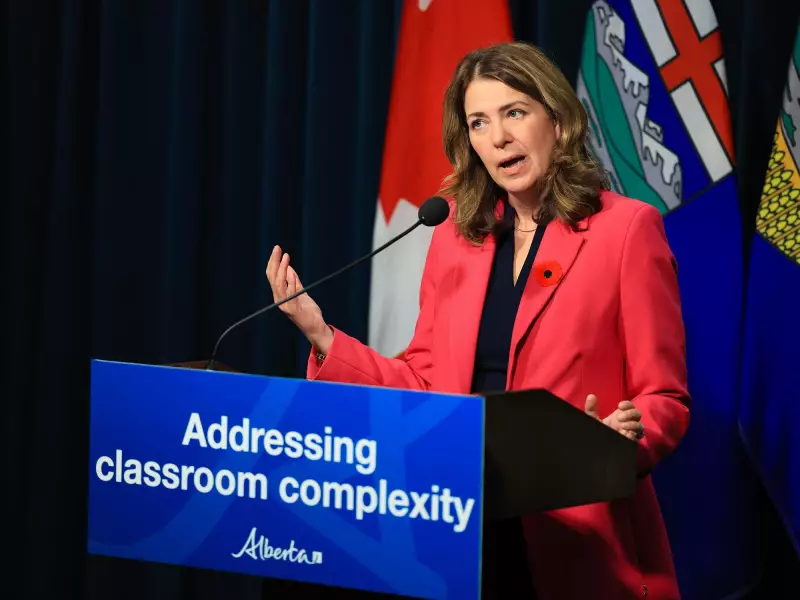
In a moment that cut through the usual political script, Alberta Premier Danielle Smith recently offered a candid assessment of the province's ongoing struggle with classroom complexity. The premier's remarks came during a November 21 news conference called to introduce a new government roadmap aimed at addressing the critical issue in Alberta's schools.
Old Recommendations for a Persistent Problem
The core of the government's new plan, as outlined by Premier Smith, hinges on recommendations from a report that is more than two decades old: the 2003 Alberta Commission on Learning (ACOL). Smith stated that the government will use this 22-year-old document as its guide to tackle modern classroom challenges. She specifically highlighted that classes should never exceed 40 students and that it is unreasonable for over half of a class to consist of students who are either non-English speakers or have mild to moderate learning complexities.
The premier's new report on aggression and complexity in schools mirrors numerous recommendations from the 2003 commission. These longstanding proposals include implementing smaller class sizes, providing stronger supports for students with complex needs, increasing access to educational assistants and clinical professionals, coordinating wraparound services, and protecting time for teachers to collaborate and plan.

A History of Political Inaction
The fact that the solutions proposed for Alberta's students and teachers in 2025 are identical to those suggested in 2003 is not a sign of a system lacking ideas. It is, instead, a glaring indicator of a system that has suffered from a profound lack of political follow-through. The ACOL recommendations initially gained attention but never saw sustained, long-term implementation.
Successive provincial governments have endorsed class-size guidelines without enforcing them, encouraged early intervention without fully funding it, and promoted integrated services without creating the structures to sustain them. This cycle of promise and inaction has left teachers, students, and families waiting for meaningful change for over two decades.
The Call for Concrete Action in Alberta's Classrooms
The clear message from education advocates is that Alberta cannot afford to repeat this cycle. There is an urgent need for the premier, the education minister, and the entire provincial government to move beyond making announcements and drive tangible actions that reach every school and classroom in the province.
Students facing developmental delays, language barriers, behavioural needs, and mental-health challenges require coordinated, cross-ministry collaboration that brings necessary specialists directly into schools. Schools need teachers and leaders who are genuinely supported within their roles, and families require predictable, sustainable funding to ensure stability.
These are not aspirational goals for a distant future; they are the same critical commitments Alberta identified and recommended more than twenty years ago. The time for promises has passed. Alberta's education system now needs decisive progress.