The Right Chemistry: The Explosive History of Soviet Nevalyaska Dolls
The story behind nevalyaska dolls is dramatic, yet less explosive than one might imagine. These charming toys, also known as roly-poly dolls, wobble when pushed but never fall over, thanks to a weighted base that rights them. While the physics is intriguing, it's the chemistry that reveals a remarkable chapter in industrial history.
A Search for Historical Plastic
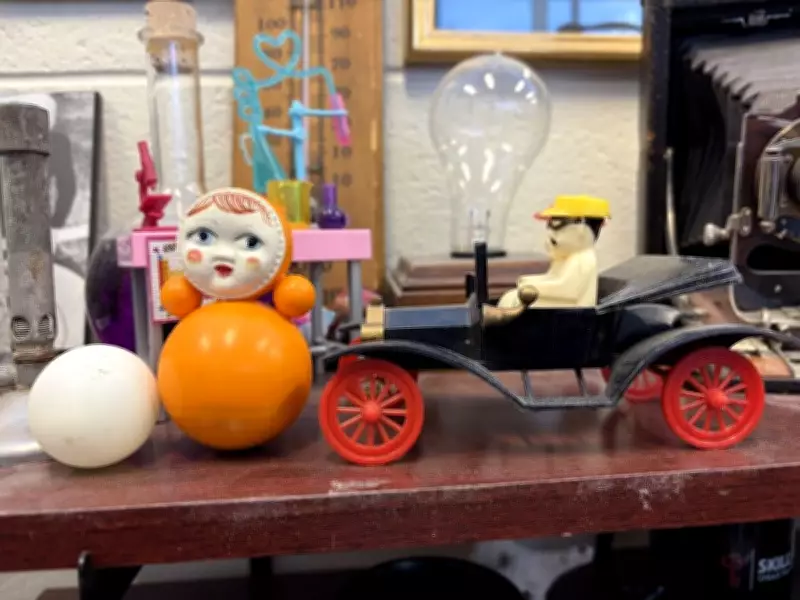
My fascination with celluloid, the world's first manmade plastic, led me to search eBay for a vintage nevalyaska. The term "nevalyaska" translates to "one who doesn't fall over" in Russian, and these dolls originally captivated me not just for their design, but for their material. I have a small collection of celluloid items that seemed incomplete without one of these Soviet-era toys.
From Gunpowder to Toys: An Industrial Pivot
The story that caught my attention involves the Tambov Gunpowder Plant in the Soviet Union. Faced with producing more gunpowder than the military required, the plant sought ways to monetize the excess. One innovative solution was converting gunpowder into celluloid, a moldable plastic with a complex history dating back to the 1800s.

This industrial pivot highlights how wartime materials can find peacetime applications, transforming explosive components into children's playthings.
The Origins of Celluloid: A Tale of Two Inventors
The invention of celluloid is credited to both Englishman Alexander Parkes and American John Wesley Hyatt, illustrating how innovation often builds upon previous discoveries. The journey began in 1832 when French chemist Henri Braconnot treated starch or wood fibers with nitric acid, producing a combustible material he called Xyloidine. Though he didn't fully understand the chemistry, he had created a mixture of nitrated starch and cellulose.
In 1846, German-Swiss chemist Christian Friedrich Schonbein made a pivotal discovery accidentally. While experimenting at home, he spilled a mixture of sulphuric and nitric acids and wiped it up with his wife's cotton apron. When he hung the apron to dry by the fireplace, it burst into flames without producing smoke. This led to the development of "guncotton" or nitrocellulose, which revolutionized warfare by providing a smokeless propellant.
From Battlefield to Billiard Balls
By the American Civil War, methods were developed to launch cannonballs with guncotton. Jules Verne even featured it as a propellant in his 1865 novel From the Earth to the Moon. In 1884, French chemist Paul Vieille ground guncotton into a powder for firearms ammunition, creating the "smokeless powder" still used today.
Meanwhile, Louis-Nicolas Menard found that nitrocellulose dissolves in ether and alcohol to form collodion, a gelatinous liquid. When dried, it leaves a flexible film, which Boston physician John Parker Maynard used as a wound dressing.
Alexander Parkes experimented with collodion, adding methanol and vegetable oil to create a moldable substance he called Parkesine, showcased at the 1862 International Exhibition in London. However, Parkesine objects warped and became brittle over time.
John Wesley Hyatt, seeking a substitute for ivory in billiard balls, discovered that adding camphor to collodion produced a durable, moldable material. In 1870, he and his brother Isaiah patented this "horn-like material," naming it celluloid. Though they likely knew of Parkes' work, their patent didn't credit him, leading to lawsuits. Courts eventually ruled that both could produce the plastic, recognizing Parkes for the original discovery and Hyatt for commercial success.
The Legacy of Celluloid
Today, celluloid has been largely replaced by non-flammable plastics due to safety concerns. However, it still finds niche uses, such as in guitar picks for their flexibility and as coatings on string instruments to enhance vibration. Ping-pong balls were made of celluloid until 2014, when the industry switched to acrylonitrile butadiene styrene (ABS) for safer transport.
The Tambov plant eventually abandoned celluloid for nevalyaska dolls due to flammability issues, switching to polyvinyl chloride (PVC). Yet, the dolls remained profitable, showcasing how industrial adaptations can endure.

My own celluloid nevalyaska, sourced from a Ukrainian seller on eBay, now sits alongside other vintage celluloid items. Though the Soviet Union has fallen, this little doll springs back up when pushed over, a testament to both its physical design and the resilient history of plastics.
Joe Schwarcz is director of McGill University’s Office for Science & Society. He hosts The Dr. Joe Show on CJAD Radio 800 AM every Sunday from 3 to 4 p.m.