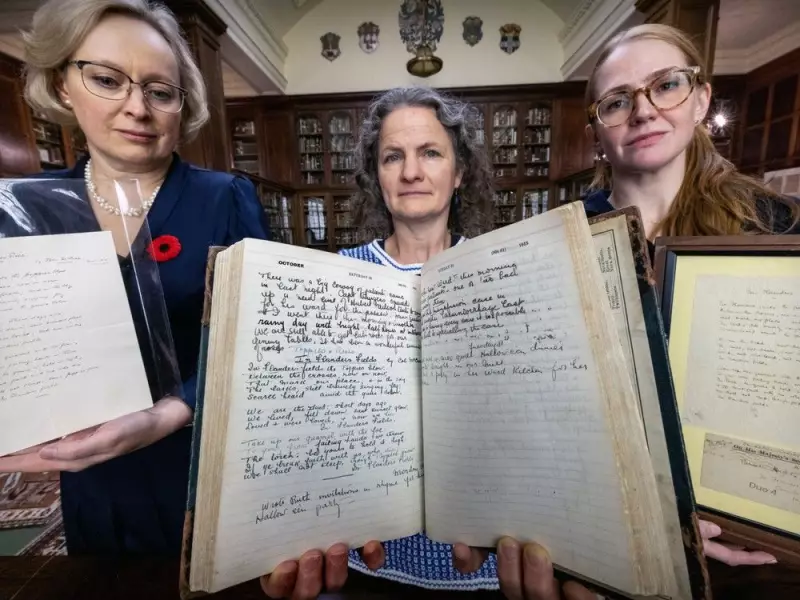
As Canadians prepare to mark Remembrance Day, four precious handwritten copies of John McCrae's iconic poem In Flanders Fields reside in Montreal, serving as powerful artifacts that reveal how the human spirit overcame the horrors of war.
Precious Manuscripts Gain International Recognition
McGill University's Osler Library of the History of Medicine holds these four handwritten versions of Canada's most famous war poem, including one in McCrae's own handwriting. The Canadian Commission for UNESCO recently recognized these original manuscripts as documentary heritage of outstanding universal value, potentially leading to their inclusion on UNESCO's international registry of significant artifacts.
"It's a little piece of a puzzle of history that we have in our hands," said Svetlana Kochkina, liaison librarian at the Osler Library. "That poem really deserves to be there because it's truly Canadian heritage. If anything is known around the world from Canadian literature, it's that poem."

The Poem's Early Circulation Among Comrades
What makes these artifacts particularly significant is that at least two of the handwritten copies predate the poem's official publication in Punch magazine in December 1915. The earliest version dates from October 1915, appearing in the diary of Clare Gass, a nurse working in McGill's field hospital during the First World War.
Mary Hague-Yearl, head librarian at the Osler Library, described the emotional impact of seeing Gass's photo album, where she had written the poem alongside photographs of freshly dug graves marked with simple wooden crosses. "Honestly, it gives me chills," Hague-Yearl said. "It does show the power at the time."
In November 1915, a month before publication, Montreal surgeon Edward William Archibald included the poem in a letter to his wife with a note saying: "Show this to mother." These early copies demonstrate how the poem circulated among McCrae's friends and colleagues before reaching the wider public.
McCrae's Own Handwritten Version Reveals Variations
The library's collection includes a copy in McCrae's own handwriting, sent to his friend Carleton Noyes in Cambridge, Massachusetts, in the spring of 1916. This version contains a fascinating variation in the first line, reading "In Flanders Fields the poppies grow" instead of the familiar "blow."
"We don't know if it's true. We don't have documentary evidence for that," Kochkina said regarding speculation that a magazine editor prompted McCrae to change the wording. "It's either the evidence that he loved his first draft better or that he continued to work on his poem after the publication."
In his accompanying letter, McCrae wrote about the beauty of the landscape surrounding the field hospital, noting the trees, flowers, nightingales and larks that stood in stark contrast to the bloodshed they witnessed daily.
Montreal's Connection to the Great War Effort
John McCrae had strong Montreal connections before the war, practicing medicine in the city and teaching at McGill University. When the First World War began in 1914, he joined the No. 3 Canadian General Hospital, established by McGill on the battlefields of France.
This medical unit started with 520 beds but expanded dramatically, eventually treating 150,000 patients and conducting 11,000 surgeries, earning a reputation as one of the best field hospitals of the war. Approximately 3,000 students, staff and faculty from McGill served in the First World War, with 365 making the ultimate sacrifice.
McCrae wrote his iconic poem in May 1915 after a friend died in a gas attack during the second Battle of Ypres. The poem almost immediately gained widespread popularity when published months later, speaking to a generation that had enthusiastically enlisted for what they thought would be a quick, glorious conflict but instead faced a long, brutal and traumatic war.

Enduring Legacy of Remembrance
Anna Dysert, coordinator for cataloguing and metadata at Osler, noted that the poem's impact was immediate and enduring. "Already, a couple of years post war, people were taking up the symbolism of the poppy," she said. "So it was immediately this poem and this symbol that people latched on to as some sort of social reconciliation with the war, as part of processing this collective trauma."
Today, In Flanders Fields stands as one of Canada's most recognized literary works, second only to Anne of Green Gables. The poem inspired the poppy campaign that remains central to Remembrance Day ceremonies across Canada and beyond.
These handwritten copies were eventually entrusted to the Osler Library for safekeeping by the descendants of their authors and recipients. While not often on public display, they have been digitized to ensure accessibility, and the public can request to view them.
McCrae himself didn't survive the war, dying of pneumonia and meningitis at a British field hospital in France in January 1918. But his powerful words continue to resonate more than a century later, ensuring that the torch of remembrance continues to be held high by new generations of Canadians.