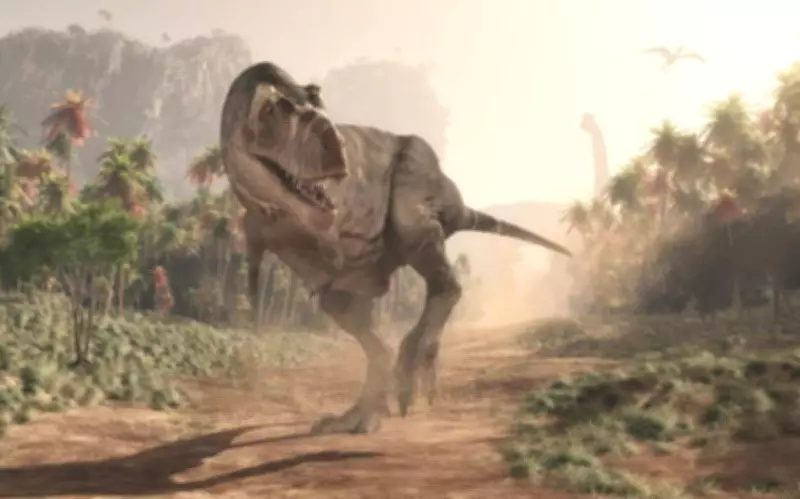
A new study has delved into the perplexing question of why the mighty Tyrannosaurus rex, one of the most fearsome predators to ever roam the Earth, possessed such disproportionately small arms. This anatomical conundrum has puzzled scientists and the public alike for decades.
The Mystery of T. Rex's Tiny Arms
Tyrannosaurus rex, often abbreviated as T. rex, was a massive carnivorous dinosaur that lived during the late Cretaceous period, approximately 68 to 66 million years ago. Despite its enormous size, reaching up to 40 feet in length and weighing up to 9 tons, its arms were only about three feet long, leading to much speculation about their function.
Previous Theories
Over the years, various hypotheses have been proposed to explain the purpose of T. rex's small arms. Some scientists suggested they were used for grasping prey, while others thought they might have been vestigial, gradually shrinking over evolutionary time. Another theory posited that the arms were used to help the dinosaur push itself up from a lying position.

The New Study's Findings
The latest research, conducted by a team of paleontologists, offers a fresh perspective. By analyzing bone structure and comparing T. rex arms to those of other theropod dinosaurs, the researchers concluded that the arms were likely used for social and mating behaviors. The study suggests that the arms may have been employed during courtship rituals, such as holding onto a mate, or for social signaling among members of the same species.
Lead author Dr. Emily Stone explained, "Our analysis shows that the arms of T. rex were not merely useless appendages. Instead, they were robust and had a range of motion that would have allowed for specific behaviors, particularly in a social context."
Implications for Understanding Dinosaur Behavior
This new interpretation adds to the growing body of evidence that dinosaurs were complex creatures with sophisticated social lives. The study also highlights the importance of reexamining long-standing assumptions with modern analytical techniques.
"We are only beginning to understand the full complexity of dinosaur behavior," said Dr. Stone. "The tiny arms of T. rex are a reminder that evolution often produces surprising solutions to the challenges of survival and reproduction."
Future Research Directions
The team plans to continue investigating other dinosaur species to see if similar patterns emerge. They also hope to use advanced imaging technology to further explore the biomechanics of T. rex arms.
This study not only provides a plausible explanation for one of paleontology's most enduring mysteries but also underscores the dynamic nature of scientific inquiry, where new evidence can transform our understanding of the past.