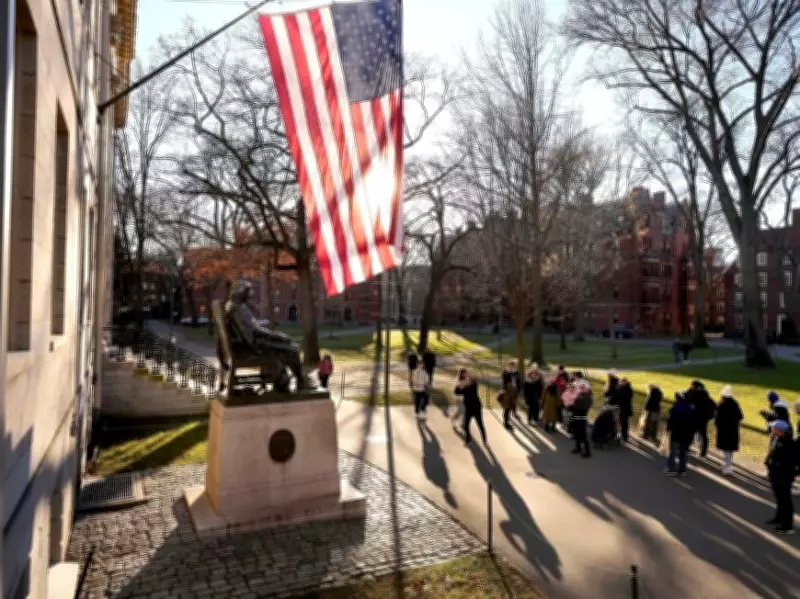
Trump Escalates Harvard Feud with $1 Billion Damage Demand
In a significant escalation of his ongoing conflict with one of America's most prestigious universities, U.S. President Donald Trump has publicly demanded $1 billion in damages from Harvard University. The demand comes amid a protracted battle that has raised fundamental questions about academic freedom, government intervention in higher education, and ideological diversity on university campuses.
Social Media Declaration Sparks Controversy
Early Tuesday morning, Trump took to his Truth Social platform to launch a fresh attack against Harvard, simultaneously criticizing the New York Times for its reporting on the administration's previous settlement demands. "Strongly Antisemitic Harvard University has been feeding a lot of 'nonsense' to The Failing New York Times," Trump wrote in his characteristically confrontational style.
The president accused Harvard of "behaving very badly" over an extended period and dismissed what he described as a "convoluted job training concept" proposed by the university. According to Trump, this proposal represented nothing more than "a way of Harvard getting out of a large cash settlement of more than 500 Million Dollars, a number that should be much higher for the serious and heinous illegalities that they have committed."

Background of the Harvard-Trump Conflict
The roots of this confrontation trace back to Trump's second term, during which he has consistently targeted Harvard with multiple punitive measures. These include attempts to withdraw federal research funding and threats to revoke the university's tax-exempt status. The initial catalyst for this conflict emerged following Hamas' October 2023 attack on Israel, when Trump accused Harvard of failing to adequately address alleged antisemitism on campus.
Unlike other institutions such as Columbia and Brown universities, which reached settlements with the Trump administration, Harvard has chosen to mount a vigorous defense. University President Alan Garber has characterized the administration's demands as evidence that "the intention is not to work with us to address antisemitism." This stance has led Harvard to file two separate lawsuits against the federal government.
Legal Proceedings and Judicial Rulings
The legal landscape surrounding this conflict has seen significant developments. In September, Harvard achieved a notable victory when a federal judge ruled that the U.S. government had unlawfully suspended research funding to the university. The judge's decision included a pointed observation that the administration had "used antisemitism as a smokescreen for a targeted, ideologically-motivated assault on this country's premier universities."
However, the Trump administration appealed this ruling in December, and the previously frozen funding has since been restored. Meanwhile, Harvard has announced that President Garber will continue in his role indefinitely, signaling the university's commitment to maintaining its current leadership through this challenging period.
Media Coverage and Administration Response
The New York Times reported on Monday that the Trump administration had abandoned its earlier demand for a $200 million settlement from Harvard. The newspaper attributed this shift to "sagging approval ratings for Mr. Trump, and as he faces outrage over immigration enforcement tactics and the shooting deaths of two Americans by federal agents in Minnesota."
Trump responded aggressively to this reporting, declaring the Times article "completely wrong" and demanding corrections. In a subsequent post, he characterized the newspaper as "a corrupt, unprincipled, and pathetic vehicle of the Left" that fails to conduct proper fact-checking. Despite these accusations, Trump has not specified the legal authority under which he would pursue the $1 billion damage claim against Harvard.
Broader Implications for Higher Education
This conflict has evolved beyond a simple dispute between a president and a university to become a national conversation about several critical issues:

- The appropriate role of federal government in regulating and funding higher education institutions
- The balance between addressing legitimate concerns about campus climate and preserving academic freedom
- The mechanisms through which ideological diversity should be fostered within university environments
- The precedent-setting nature of using financial leverage to influence university policies and practices
As this confrontation continues to unfold, it raises important questions about the future relationship between government and academia in the United States. The outcome could establish significant precedents affecting how federal administrations interact with educational institutions, particularly regarding controversial social and political issues.