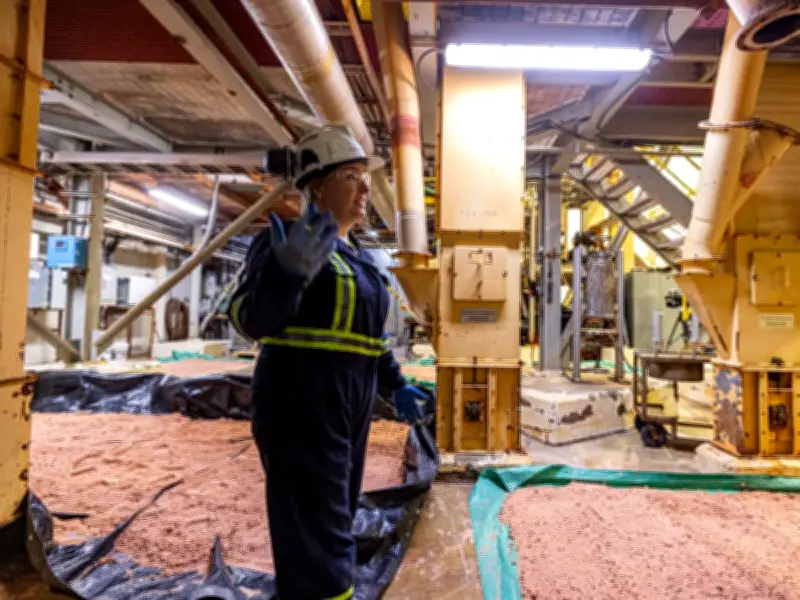
At Innovation Place on the University of Saskatchewan, a nondescript brick building houses the world's largest potash miner's testing ground for new operational technologies before they are deployed across six Saskatchewan mines. The Nutrien Pilot Plant, operational since 1981, recently opened its doors to media for the first time, showcasing its role in advancing potash processing.
Mock Mine Simulation
Tests are conducted in a "mock" mine that simulates underground conditions. A large warehouse contains a steel-framed compaction circuit where various machines compress mined ore into uniform materials, making potash extraction easier. The intermittent sound of a compressor punctuates the otherwise silent space.
Technological Evolution
Matthew Gillespie, manager of process control and operational technology, highlighted the stark contrast between modern mines and those from the late 1950s. Early operations relied on hydraulic equipment and manual levers and valves. Today, air actuation enables remote control of valves and other machinery. "Now we have air actuation where we can remotely control the valves and stuff like that," Gillespie said.

Efficiency Gains
Mark Buchinski, mill process and pilot plant director, has been with Nutrien since 2009. He noted the facility's role in developing improved flotation methods to extract more potash from ore. "We're actually making more potash with the same amount of ore, and that overall drives a significant efficiency in the potash unit," he explained. The flotation facility features a tight space where wet ore rotates in a small drum among other processes.
Hydro Cyclones Success
One standout technology tested at the plant is hydro cyclones, which separate potash from coarse materials using a slurry in a cylinder. During expansions in the 2010s, the company brought hydro cyclones to the pilot plant for preparation and troubleshooting. Buchinski said, "They started up and worked well." The plant also includes a process control workshop, server room, wet chemistry lab, flotation chamber, welding shop, and office spaces.
Ongoing Innovation
Workers rake potash spread on tarps for sampling in lab facilities. Buchinski emphasized that the pilot plant supports daily operations while keeping an eye on future technologies. The potash industry in Saskatchewan spans over 60 years, with significant technological advancements transforming operations from manual to automated systems.