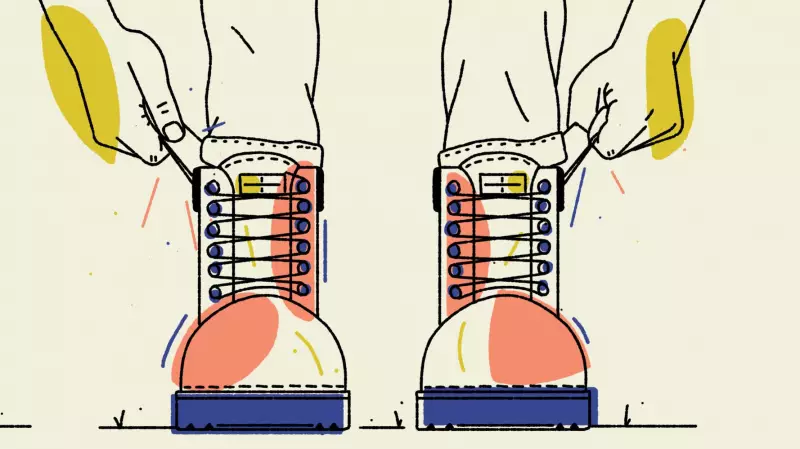
The iconic phrase "pull yourself up by your bootstraps" is a staple of political rhetoric, especially in discussions about individualism and success. It champions the idea of achieving prosperity through sheer personal effort, without external aid. Yet, a dive into its history reveals a startling contradiction: the original meaning described something utterly impossible.
An Origin Rooted in the Absurd
The earliest known published reference dates to September 30, 1834, in an American newspaper. Linguist Ben Zimmer and etymologist Barry Popik trace it to a snarky comment in the Mobile Advertiser. The paper was mocking a man named Nimrod Murphree, who claimed to have discovered perpetual motion. The editors wrote he might as well have succeeded in "handing himself over the Cumberland river, or a barn yard fence, by the straps of his boots."
"Bootstraps were a typical feature of boots that you could pull on... but of course bootstraps wouldn't actually help you pull yourself over anything," Zimmer explained to HuffPost. "The original imagery was something very ludicrous."

For decades, the phrase was used to denote a foolish endeavour. Examples abound, from The North American Review in 1867 to Popular Mechanics in 1908, all using it as a metaphor for a futile effort. Some have even linked its sentiment to the tall tales of Baron Munchausen, a fictional German noble who claimed to pull himself from a swamp by his own hair.
The Pivot to a National Ethos
The transformation from absurdity to aspiration appears to have solidified in the early 20th century. The Oxford English Dictionary cites James Joyce's 'Ulysses' (1922) as an early example of the modern meaning. By 1927, Britain's Sunday Times was sarcastically referring to the headstrong "American bootstrapper."
"It's hard to explain why the meaning of an expression changes over time," said Zimmer. "Sometimes things start off with an ironic or humorous edge, but that gets forgotten... Nobody's thinking of the impossible image of pulling themselves over a fence." He suggests this shift might say something about the American—and by extension, a certain Canadian—perspective: turning the ludicrous into an idiom for self-improvement.
Does the Contradiction Matter?
For lexicographers, the evolution is natural. Grant Barrett, co-host of "A Way with Words," dismisses the "etymological fallacy"—the mistaken belief that an older meaning is more correct. "The saying does its new job as well as it did its old job," he stated, comparing it to other hyperbolic idioms like "busted her ass" or "head exploded."
However, the irony isn't lost on critics. Writer John Swansburg, in a piece called "The Self-Made Man," highlighted this fault line. "The very language we use to describe the self-made ideal has these fault lines embedded within it," he wrote, noting the phrase's foundation in impossibility.
Today, the phrase and its derivative "bootstrapping" are ubiquitous, used in politics, business, tech, and self-help. Ultimately, as Zimmer concludes, "Looking for logic in language is a fool's errand." It might be as foolish, in fact, as trying to pull yourself up by your bootstraps.