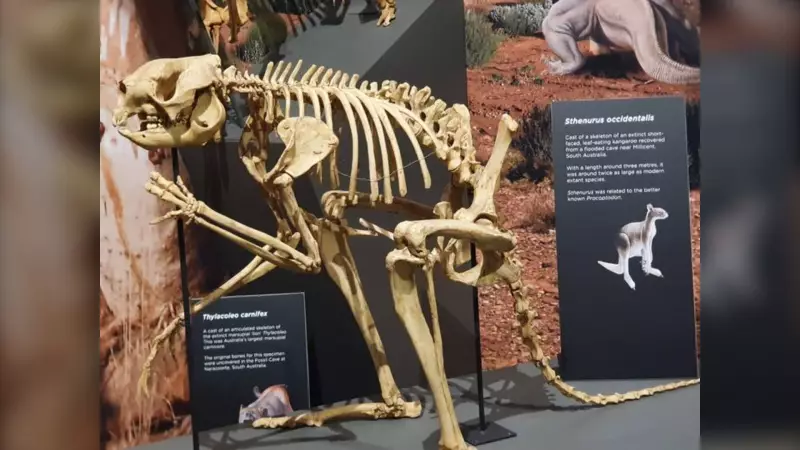
Groundbreaking Fossil Analysis Rewrites Understanding of Giant Kangaroo Locomotion
A significant paleontological discovery is reshaping our understanding of Australia's prehistoric megafauna. Researchers examining sthenurine kangaroo fossils have presented compelling evidence that challenges a long-standing scientific consensus regarding these giant marsupials' mobility.
Reevaluating Prehistoric Movement Patterns
For decades, the prevailing theory among paleontologists suggested that sthenurine kangaroos, which stood over two meters tall and weighed more than 200 kilograms, were physically incapable of hopping. Scientists had hypothesized that their substantial body size and unique skeletal structure limited them to walking on two legs, similar to how humans ambulate.
The new research, centered on exceptionally preserved specimens housed at the South Australian Museum, provides a different narrative. Detailed analysis of limb bones, pelvic structure, and spinal alignment indicates these massive creatures possessed the anatomical adaptations necessary for hopping locomotion.

Anatomical Evidence Tells a Different Story
The skeletal remains reveal several key features previously overlooked or misinterpreted:
- Powerful hind limb bones with attachment points for substantial musculature
- A reinforced pelvic structure capable of withstanding the impact forces generated by hopping
- Spinal adaptations that would have facilitated the characteristic kangaroo bounding motion
- Proportionally longer feet than previously recognized, providing better leverage for propulsion
"This discovery fundamentally changes how we envision these magnificent animals moving through their environment," explained lead researcher Dr. Megan Jones. "Rather than the slow, bipedal walk we imagined, they likely employed a powerful, bounding gait that allowed them to cover substantial distances efficiently."
Implications for Understanding Australian Megafauna
This revised understanding of sthenurine locomotion has broader implications for reconstructing Pleistocene ecosystems in Australia. If these giant kangaroos could hop, they would have been more mobile than previously thought, potentially influencing:
- Their foraging patterns and territorial ranges
- Interactions with other megafauna and early human populations
- Evolutionary pressures that shaped their development and eventual extinction
- The ecological role they played in shaping Australia's unique prehistoric landscape
The research team employed advanced imaging techniques and biomechanical modeling to reach their conclusions, comparing the sthenurine fossils with both modern kangaroo skeletons and computer simulations of potential movement patterns.
This discovery underscores how ongoing fossil analysis continues to refine our understanding of prehistoric life, reminding us that even long-established scientific beliefs must remain open to revision when confronted with new evidence. The study represents a significant contribution to paleontology and our comprehension of Australia's remarkable evolutionary history.