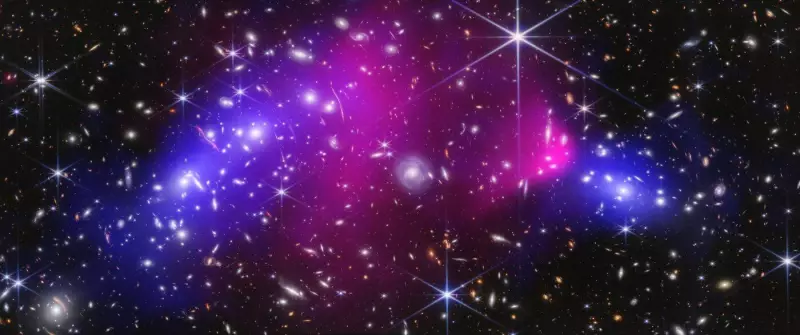
New Galactic Map Illuminates the Path to Deciphering Dark Matter
A groundbreaking new map of far-off galaxies is offering scientists a clearer window into one of the universe's most profound mysteries: dark matter. This invisible substance, which does not emit, absorb, or reflect light, is believed to constitute about 85% of the matter in the cosmos, yet its exact nature remains elusive. The map, developed using advanced observational data, represents a significant step forward in astrophysical research, potentially reshaping our understanding of cosmic structure and evolution.
Harnessing NASA's Observational Power
The creation of this map relies heavily on data from two of NASA's premier space observatories: the James Webb Space Telescope and the Chandra X-ray Observatory. These instruments capture complementary views of the universe, with Webb providing detailed infrared imagery of galaxies and Chandra detecting X-ray emissions from hot gas and energetic events. By combining these datasets, researchers can infer the presence and distribution of dark matter, often visualized in blue overlays on images, as it influences the motion and clustering of visible matter through its gravitational pull.
This collaborative approach allows scientists to study massive galaxy clusters in unprecedented detail. Dark matter's gravitational effects are most pronounced in these dense regions, making them ideal laboratories for testing theories. The map not only charts the locations of galaxies but also highlights areas where dark matter is likely concentrated, offering clues to its properties and interactions with ordinary matter.

Implications for Cosmology and Beyond
The enhanced understanding of dark matter facilitated by this new map could have far-reaching implications. In cosmology, it may help refine models of the universe's expansion and the formation of large-scale structures. For instance, by analyzing how dark matter clumps around galaxies, researchers can test predictions of the standard model of particle physics and explore alternative theories, such as those involving weakly interacting massive particles (WIMPs) or modifications to gravity.
Moreover, this research contributes to a broader scientific effort to unravel the universe's fundamental components. Dark matter is a key piece of the cosmic puzzle, and mapping its distribution brings us closer to answering long-standing questions about the nature of reality. As technology advances, future iterations of such maps, possibly incorporating data from other observatories, could provide even sharper insights, driving innovation in both theoretical and applied physics.
In summary, the new map of distant galaxies represents a pivotal advancement in the quest to comprehend dark matter. By leveraging cutting-edge technology and interdisciplinary collaboration, scientists are peeling back the layers of this cosmic enigma, promising to deepen our knowledge of the universe and inspire further exploration in the years to come.