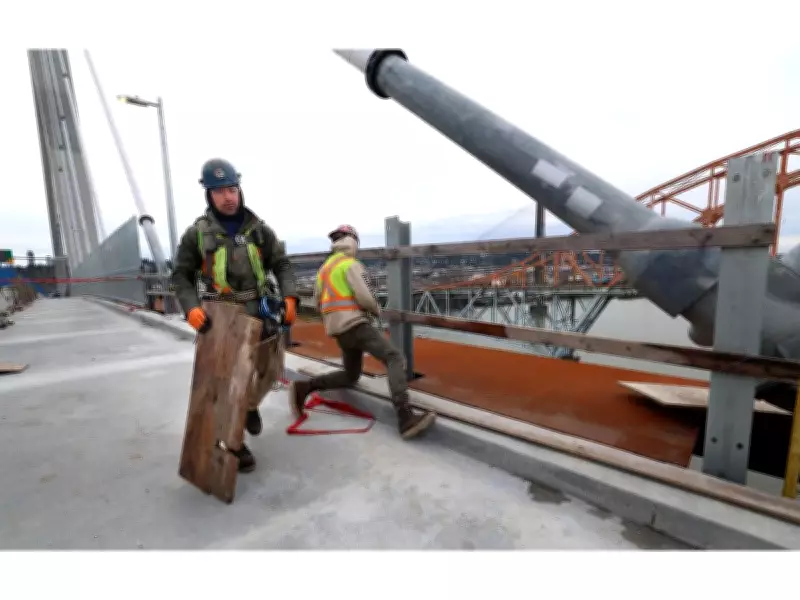
Pattullo Bridge Demolition Begins: Controlled Dismantling Over Two Years
The distinctive orange Pattullo Bridge, a 90-year-old landmark spanning the Fraser River, has officially begun its carefully orchestrated deconstruction. Workers have already created a significant gap—approximately one-third the length of a football field—on one end of the structure, marking the start of a meticulous demolition process that will unfold over nearly two years.
Piece-by-Piece Removal Process
Residents and commuters will witness the gradual disappearance of the bridge as crews equipped with jackhammers and heavy machinery chip away at the structure month by month. According to Navjeet Tiwana, executive project director for the Pattullo Bridge replacement project, the demolition is being conducted with extreme precision.
"For the areas above water, the lowering of materials and everything is very controlled to make sure we're not dropping anything," Tiwana explained, noting that above-land sections allow for slightly less stringent measures. The initial phase has focused on dismantling the section connecting to McBride Avenue in New Westminster, where the first two concrete beams have been removed.

Historical Significance and Safety Concerns
Built in 1937 and named after British Columbia Premier Duff Pattullo (1933-1941), the bridge served as the primary crossing between Surrey and New Westminster for decades. Safety concerns emerged about ten years ago, prompting plans for a replacement structure that would meet modern standards with wider lanes and a center median.
With the new stal̕əw̓asəm Bridge now operational—featuring four lanes across the Fraser River—the provincial government has moved forward with demolishing the aging Pattullo. Work commenced two weeks ago, following the opening of the replacement crossing.
Three-Phase Demolition Strategy
The demolition follows a carefully planned three-phase approach:
- On-land sections (currently underway)
- Above-water structure including bridge deck, steel truss, and archway
- Below-water materials including piers and foundations
Tiwana detailed the complexity of the operation: "Because of the railway crossings underneath, we have to do a hybrid of taking pieces off, and there's water channels, so we have to deconstruct it piece by piece." Barges will be positioned in the water to receive materials as columns are removed sequentially.
Environmental Considerations and Timeline
Environmental protections play a crucial role in the demolition process. Wendy Itagawa, former executive project director for the new bridge and current vice-president of major projects for the Transportation Investment Corporation, emphasized the need to protect aquatic life.
"Under the Department of Fisheries and Oceans, there are restrictions around how much noise and vibration we can have," Itagawa noted. "Whatever methodology we land on, we have to make sure to protect the fish."
The underwater portion of the demolition awaits permitting, but will likely involve mechanical removal using specialized tools pressed against concrete slabs. Tiwana explained that the process isn't uniform: "It can't be one size fits all." For instance, sections with less steel may allow for larger pieces to be removed together, reducing overall work.
Project Financing and Completion
The entire demolition is projected to conclude by the end of 2027. Notably, the removal costs have been incorporated into the $1.6 billion budget for the new bridge construction project, meaning no additional provincial funds are required for dismantling the Pattullo.
As the careful deconstruction continues, the iconic orange structure that has defined this stretch of the Fraser River for nine decades will slowly vanish, making way for a new era of transportation infrastructure while respecting environmental concerns and community safety.