

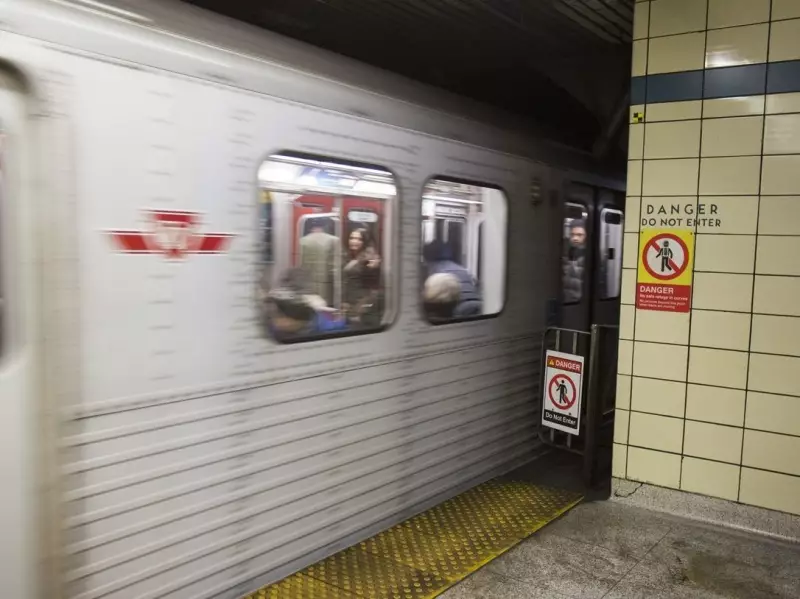
A striking comparison between two of the world's major subway systems reveals a profound disparity in safety and public order. While London's historic Underground moves millions daily with relative calm, Toronto's Transit Commission (TTC) grapples with a dramatic and troubling surge in violent crime and social disorder.
A Tale of Two Transit Networks: Scale vs. Safety
London's Underground, known as the Tube, is a behemoth. Spanning approximately 400 kilometres, it is essentially ten times the length of Toronto from east to west. It serves close to 300 stations across more than a dozen lines. In contrast, Toronto's subway system operates just four lines connecting about 75 stations.
Despite its vastly larger scale and passenger volume, the London system maintains a significantly lower crime rate. For every million journeys taken on the Underground in 2025, only 20.7 crimes were reported, with most being thefts or incidents of anti-social behaviour.

The Alarming Reality on the TTC
The situation in Toronto presents a stark and worsening contrast. Between 2016 and 2024, crimes on the TTC—including serious offences like attempted murder, extreme violence, and sexual assaults—surged by more than 160%. A Toronto Sun analysis from July 2025 found that TTC constables, while on patrol, take someone into custody under the Mental Health Act once every four shifts.
Reporting on over 1,150 incidents from a few months in 2020, journalist Justin Holmes documented a range of events from petty crime to aggravated assault and attempted murder. His reports highlighted repeated issues, including narcotics use and public disturbances, with incidents occurring at every single subway station in Toronto. The problem has intensified since the pandemic.
Toronto is not alone in this trend. Violent crime on transit has exploded across major Canadian cities. Between 2015 and 2024, such crime nearly tripled in Winnipeg and more than doubled in Edmonton, Montreal, Kitchener-Waterloo, and Toronto itself.
How London's Underground Fosters Safety and Civility
Observers point to several integrated strategies that contribute to the safer environment on the Tube. An extensive closed-circuit television (CCTV) system monitors virtually every inch of public space. The presence of Transport for London staff, British Transport Police, and regular transit employees is highly visible throughout the network.
The system also features around 500 commuter-assistance "help points" where travellers can instantly connect to staff or a control room. Proactive measures include crowd management during peak times, widespread anti-suicide initiatives, and constant public announcements encouraging riders to "See it, say it, sort it" by reporting any suspicious activity.
Beyond security infrastructure, a culture of courtesy and efficiency is palpable. Stations are well-maintained, with polite signage and announcements. There is a notable emphasis on mutual respect, with clear warnings that staff abuse, sexual harassment, and hate crimes "have consequences." The general behaviour of commuters—often occupied with books or devices—creates a less vulnerable environment.
The Call for Action in Toronto
Toronto Councillor Brad Bradford, who has addressed the transit safety crisis, stated plainly: "Transit safety is a major issue in Toronto. Riders deserve real protection—and enforcement that will actually keep them safe." While Toronto and other Canadian cities employ some similar anti-crime measures as London, the outcomes differ drastically.
The core distinction may ultimately be cultural. The London Underground succeeds not merely because of cameras or police, but because a collective decision appears to have been made by authorities, staff, and the public to uphold a standard of civility. As crime continues to challenge Canadian transit systems, the lesson from London is that safety requires a holistic commitment to order, respect, and proactive care for the public realm.






