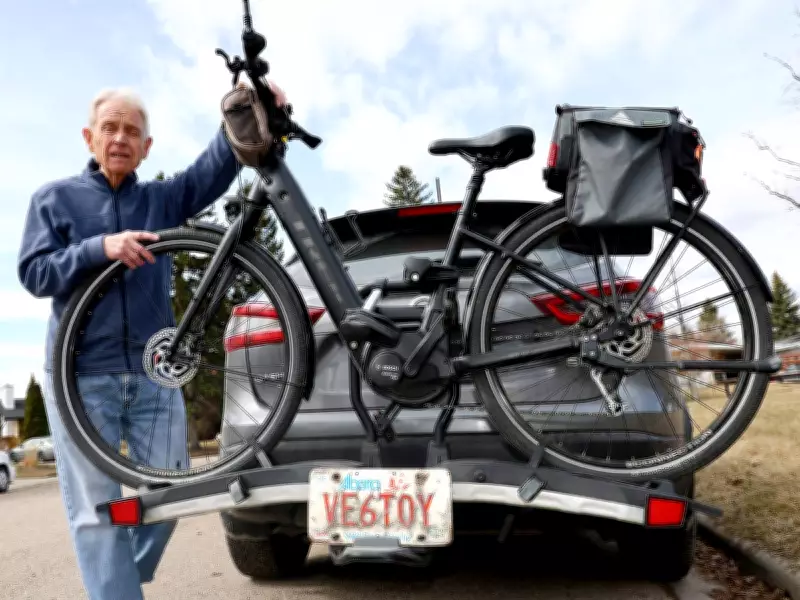
Two dedicated senior cyclists from Calgary are leading a campaign for regulatory change, calling on the provincial government to permit secondary license plates specifically for use with bike racks. This initiative aims to address mounting concerns over costly fines resulting from obscured plates, which they argue unfairly impact older riders.
The Problem: Obscured Plates and Hefty Penalties
Peter Whitehead, 81, and David Hedmann, 75, are active members of a local seniors cycling club boasting nearly 300 participants. They highlight that current regulations are ambiguous, leading to significant financial penalties. Some club members have faced fines exceeding $140 for license plates blocked by bike racks, a substantial burden for those on fixed incomes.
According to Calgary police, violations for driving without a securely attached, legible, or clearly visible license plate can incur a $162 fine. Whitehead emphasized the severity of this cost, stating, "It's a lot of money for a senior." Enforcement data reveals fluctuations in ticketing for obstructed plates, with incidents rising from 923 in 2021 to 1,395 in 2024 before dropping to 937 in 2025, though these figures are not exclusively tied to bike rack cases.

Current Solutions Fall Short for Older Adults
Whitehead reported that Service Alberta recommended relocating the license plate from the vehicle to the bike rack when in use to avoid fines. However, he criticized this approach as impractical, especially for seniors with mobility or dexterity limitations. "Have you ever tried to take your licence plate off after it's been on there for a year? The bolts are all rusted — it's not a trivial matter," he explained.
Hedmann echoed these concerns, noting the physical challenges involved. "I'm 75, and when I've got to crawl around and mount my bike rack on my car, you know, it's an effort," he said. "It's an ongoing issue." Both cyclists argue that this solution is cumbersome and fails to account for the realities faced by aging populations.
Proposed Change: Secondary License Plates
The cyclists advocate for Alberta to allow secondary license plates designed for bike rack use, a modification they believe would streamline compliance and reduce fine risks. Whitehead suggested this option would make processes "infinitely easier" for seniors and alleviate enforcement anxieties.
Hedmann compared the proposal to existing provisions for trailers, calling it the "simplest" solution. "We're trying to motivate the government to make a decision that reflects the needs of people with bike racks," he stated. Currently, Alberta issues only one rear license plate per vehicle, with rules prohibiting the display of multiple plates, underscoring the need for regulatory adjustment.
Industry Perspectives and Enforcement Realities
Businesses catering to Calgary cyclists acknowledge widespread confusion over license plate visibility rules. However, many riders remain unconcerned about ticketing due to perceived limited enforcement for offences involving loaded bike racks. This discrepancy highlights the inconsistent application of regulations and the urgent need for clarity.
The cyclists' push for secondary plates not only addresses immediate compliance issues but also promotes safer and more accessible cycling for older adults. As Whitehead and Hedmann continue their advocacy, they hope to spark governmental action that supports active lifestyles without imposing undue financial or physical burdens on seniors.