

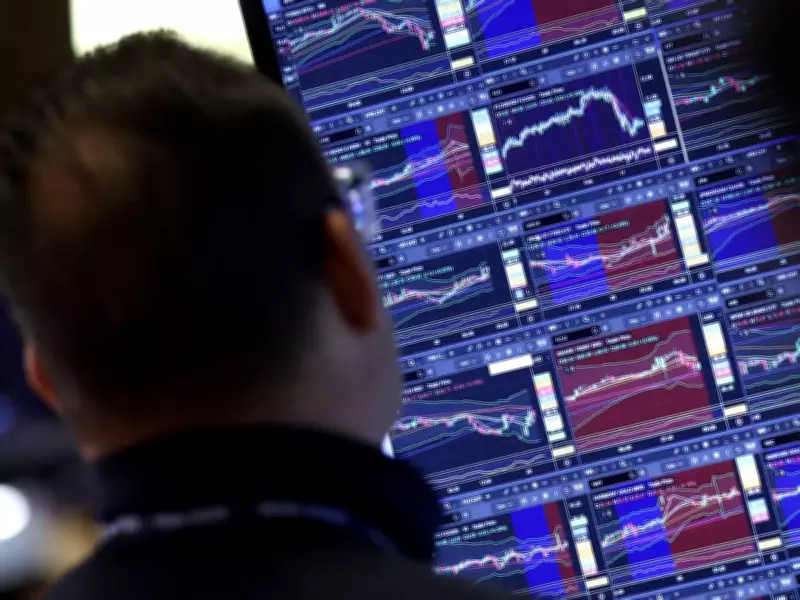
Wall Street investors are currently navigating a landscape of profound uncertainty regarding artificial intelligence, with the prevailing sentiment leaning heavily toward caution over conviction. This heightened wariness reflects the complex and often contradictory signals emerging from Silicon Valley and the broader business ecosystem.
A Market Shaken by Speculative Fiction
Over the past year, Wall Street has experienced multiple waves of AI-related selloffs, driven by fears ranging from cost-efficient competition in China to concerns about an impending AI bubble. However, a recent market dip introduced a novel catalyst: a self-published work of dystopian fiction. Citrini Research, a relatively obscure investment research firm, released a lengthy blog post titled "The 2028 Global Intelligence Crisis." This speculative essay envisions a near-future scenario where highly capable AI agents have displaced vast numbers of white-collar jobs, leading to collapsed consumer spending and a global deflationary spiral within two years.
Immediate Market Reactions
The publication had tangible financial consequences. Companies mentioned in the blog post, including Uber, DoorDash, Mastercard, and Visa, saw their stock prices tumble as investors grappled with the bleak scenario. Mainstream economists were quick to criticize the report, with Pierre Yared, acting chair of the White House Council of Economic Advisers, dismissing it as "science fiction." Nonetheless, the market reaction underscored the fragile state of investor psychology.

The Core of Wall Street's AI Dilemma
This episode represents perhaps the most extreme indication yet that Wall Street is struggling to comprehend AI's trajectory. For months, public market investors have worried that AI technology might not generate sufficient returns to justify its enormous development costs. Now, a new concern is gaining traction: that AI could be so profoundly disruptive that it destabilizes countless software providers and established businesses.
Fragile Sentiment and Incremental Releases
Recent weeks have seen various sectors rattled by a series of largely incremental AI product announcements. These range from an AI-powered tax tool developed by a small wealth management startup to an AI logistics offering from a former karaoke company. Remarkably, even the mere mention of a company's name during a livestreamed event by AI firm Anthropic was enough to influence stock movements.
Heath Terry, global head of technology and communications research at Citi, commented on the situation following the Citrini post, stating, "It just taps into how fragile the investor sentiment is right now. There aren't a lot of strongly held convictions out there. All it takes is somebody to put together a doomsday scenario and it's enough to shake some people out of their positions in this kind of environment."
Intentions Behind the Provocation
The authors of the Citrini report stated that their goal was to be provocative, serving as a call-to-action for investors, technology leaders, and policymakers. Alap Shah, a co-author and former Citadel staffer who now runs AI firm Littlebird and holds an executive role at Lotus Technology Management, explained, "It feels like in society right now, there is a sort of existential dread around what's happening with AI. This essay was an opportunity to put a scenario out there that would galvanize folks a little bit."
Despite outlining a nightmare scenario, Shah clarified that "software business won't erode overnight" and expressed his belief that "the Street tends to get it right" in the long term. This nuanced perspective highlights the tension between alarmist speculation and pragmatic assessment.
Reflecting Broader Mixed Messages
Ultimately, the current uncertainty on Wall Street mirrors the mixed messages emanating from Silicon Valley and the wider business community. Investors are caught between optimistic projections of AI-driven growth and dire warnings about its disruptive potential, leading to a market environment where sentiment is easily swayed by both substantive developments and speculative narratives.






