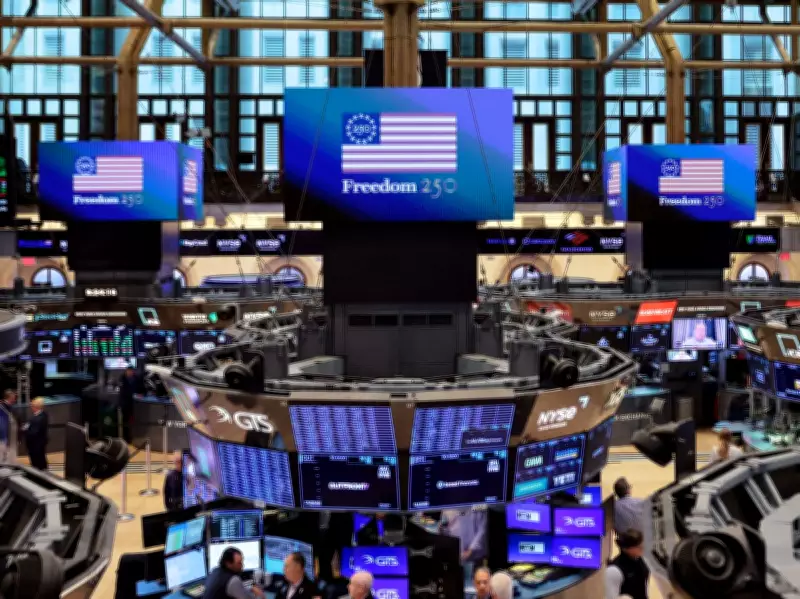
Record Stock Market Rally Hides Underlying Weaknesses and Red Flags
The United States stock market has achieved a record-breaking advance, yet this rally exhibits many characteristics of an unloved surge. Key indicators such as narrow leadership, low trading volumes, and muted investor sentiment suggest underlying fragility despite the impressive gains.
Market Performance and Geopolitical Influences
The equities benchmark has surged almost nine percent in April, closing above the 7,000 mark for the first time last week. Simultaneously, the tech-heavy Nasdaq 100 experienced a 13-session rally, marking its longest winning streak since 2013. However, this streak was interrupted on Monday as investors closely monitored prospects for further peace talks between the United States and Iran.
Both major gauges soared following the ceasefire agreement reached approximately two weeks ago. Nevertheless, Wall Street strategists caution that these gains may be on shaky ground, with several red flags emerging.

Narrow Leadership and Investor Caution
One significant concern is the limited group of shares driving the advance. When the S&P 500 index set a record last week, only about half of its members traded above their 50-day averages. This level is substantially lower than those observed during the index's previous all-time peak in January and the historic high reached after last year's tariff turmoil.
JC O'Hara, chief technical strategist at Roth Capital Partners LLC, noted, "They're forced to like certain things, but they do not love the whole package." He added that the rally's unfolding implies "the bulk of the gains are probably behind us."
Trading Volumes and Sentiment Indicators
Trading volume on the S&P 500 in April has been 11 percent below the six-month average, according to data compiled by Bloomberg. In contrast, March saw volumes 9.6 percent above that average. To O'Hara, this discrepancy indicates that investors had more conviction in the declines than in the recovery.
"We don't have an all-clear sign on the macro front," he explained. "Investors are a little skittish to fully jump back in."
A Barclays PLC measure of investor sentiment has declined even as the S&P 500 has surged. The bank describes this as an "uncommon outcome given the speed of the rebound." Indeed, there have been only five other instances in the past two decades where this indicator slipped during a sharp recovery.
Expert Insights on Market Dynamics
Stefano Pascale, head of U.S. equity derivatives at Barclays, observed, "Euphoria around stocks has failed to lift off significantly, which is usually not the case whenever the S&P 500 recovers from a deep selloff."
Mark Hackett, chief market strategist at Nationwide, attributed the rebound to a combination of speculators exiting bets on equities losses and institutional investors who had been underweight being "pulled from the sidelines."
Additional Headwinds and Performance Metrics
Beyond international tensions, expectations of weaker corporate guidance this earnings cycle add to the concerns. Collectively, these factors provide investors with reasons to hold off on full commitment.
On Monday, the S&P 500 index fell 0.2 percent. An equal-weight version of the index gained 0.3 percent but remains 0.4 percent from its most recent record in February. The old-economy Dow Jones Industrial Average is down 1.5 percent from its peak. Futures on the S&P 500 traded up 0.4 percent at 7:18 a.m. Tuesday in New York.
Unforeseen headwinds for the market include the potential for AI disruption and the duration of the Iran war, which could further impact stability. As the rally continues to mask these red flags, experts urge caution amid the record highs.